 Apache County Land Services
Water Well Drilling • Private Wells • Well Pumps • Rural Water Systems
Connect With Local Water Well Professionals
(928) 543-6447
Apache County Land Services
Water Well Drilling • Private Wells • Well Pumps • Rural Water Systems
Connect With Local Water Well Professionals
(928) 543-6447⭐ Water Well Drilling • Private Wells • Well Pumps • Rural Water Systems • Off-Grid Water Infrastructure Across Apache County Arizona
Need a private water well for your rural property? Apache County Land Services connects property owners with experienced water well drilling professionals for homes, cabins, ranches, manufactured homes, livestock properties, and off-grid developments throughout Apache County. Get connected for new well drilling, well pumps, private water systems, well-to-house water lines, and related water infrastructure based on your property's location, groundwater conditions, intended water use, access, and development plans.
Connecting property owners with water well professionals serving St. Johns, Concho, Vernon, Sanders, Springerville, Eagar, Alpine, Greer, Nutrioso, McNary, Ganado, Window Rock, and surrounding Apache County communities.
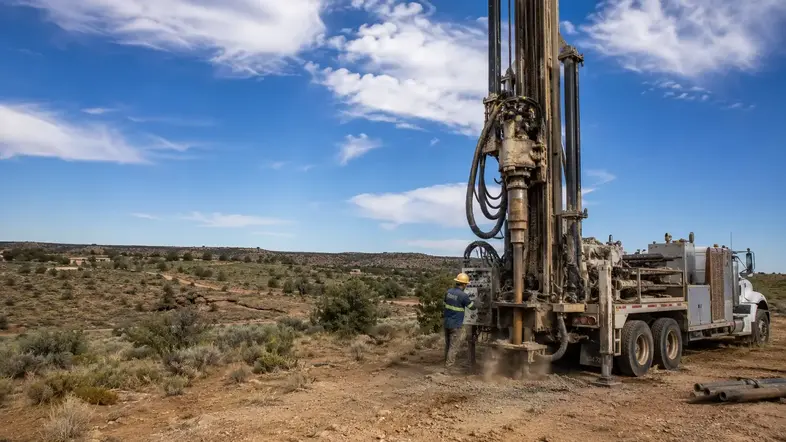
Choosing where to drill a private water well is one of the most important decisions in developing rural Apache County property. A suitable well location needs to be considered in relation to groundwater conditions, terrain, geology, access, existing improvements, septic systems, future buildings, utility routes, and the property's intended water use. Evaluating these factors before drilling can help avoid unnecessary costs and reduce conflicts with future development.
Apache County properties can vary substantially in elevation, geology, soil conditions, vegetation, drainage, and access. A well location that works well on one parcel may not be appropriate on another. Well drilling decisions should therefore be based on the specific property and the requirements of the proposed water system rather than assuming that groundwater conditions are the same throughout the county.
Before drilling, important considerations can include:
This evaluation is particularly important for large-acreage and undeveloped Apache County properties where the proposed homesite may be far from established roads, utilities, or other infrastructure. A parcel can appear straightforward from a listing or satellite image while having significant differences in elevation, rock conditions, drainage, groundwater potential, and equipment access at the actual proposed well location.
The goal is not to guarantee a particular well depth or water yield before drilling. Instead, the objective is to identify a practical drilling location, understand the property's known conditions, plan equipment access, coordinate the well with future infrastructure, and establish realistic expectations before substantial drilling costs are incurred.
For property owners planning a home, cabin, ranch, manufactured home, livestock operation, or off-grid development, useful information to have ready includes the property location, intended water use, approximate building area, existing access, known nearby wells, planned septic system, future structures, and whether the property will use conventional electrical service or an off-grid power system.
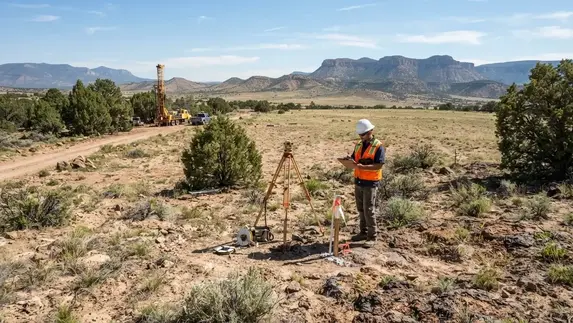
A private water well location should be evaluated in relation to groundwater conditions, drilling access, terrain, septic planning, future construction, and the property's long-term development plan.
Before drilling begins, the proposed well location should be considered in relation to groundwater conditions, drilling-rig access, septic planning, the future homesite, utility routes, water demand, and other planned improvements. If you're developing rural or off-grid property in Apache County, we can connect you with water well drilling and water-system professionals who can evaluate the project and discuss the appropriate next steps.
Call (928) 543-6447A private water well can be one of the most important infrastructure decisions on a rural Apache County property. Before drilling begins, the well location, expected groundwater conditions, access, intended water use, pump requirements, and relationship to the future home or other improvements should all be considered. A dependable water system starts with choosing an appropriate drilling approach for the property rather than simply drilling wherever equipment can reach.
Apache County Land Services connects rural property owners with water well drilling and water-system professionals who can evaluate the property, discuss the intended water use, and help determine the appropriate approach for drilling, well equipment, pumps, storage, and related water infrastructure. This can be especially important for undeveloped, remote, ranch, and off-grid properties where there may be no municipal water connection.
Groundwater conditions can vary significantly across Apache County. The property's location, surrounding terrain, known wells, geological conditions, access, and intended use can all influence the planning process. Providing the exact property location and basic project information gives the well professional a better starting point for evaluating the project.
The best well location is not necessarily the most convenient spot on the property. Site considerations can include terrain, access for the drilling rig, existing and future improvements, drainage, septic locations, property layout, and other known constraints. A site evaluation helps identify a practical drilling location before equipment is mobilized.
Apache County contains varied terrain and subsurface conditions, including areas with hard rock, volcanic material, sedimentary formations, alluvial deposits, and other geological conditions. These factors can affect drilling methods, expected depth, drilling time, casing requirements, and overall project cost. Actual conditions can only be determined through appropriate site evaluation and drilling.
A water well should be considered as part of the property's larger development plan. The future home or cabin, building pad, driveway, septic system, utility routes, solar equipment, livestock areas, and outbuildings can all affect where water infrastructure should be located. Planning these improvements together can reduce unnecessary excavation and future disruption.
A residential homesite, full-time rural residence, ranch, livestock operation, and off-grid property can have very different water requirements. Well-system planning should consider the number of occupants, household use, livestock, irrigation, storage requirements, and other intended uses so the pump and water-system components are matched to the property's actual needs.
Drilling the well is only part of creating a usable water system. Pump selection, pressure equipment, controls, storage, electrical requirements, and the depth of the water source all affect how the completed system performs. The appropriate equipment should be selected based on the completed well and the property's intended water use.
Remote Apache County properties may need a water system that operates independently from municipal infrastructure. Depending on the property, this can involve a private well, solar-powered pumping, battery or generator backup, pressure equipment, and water storage. Planning the water system alongside the property's energy system can make the overall off-grid design more practical.
A well does not necessarily need to supply every gallon of water at the exact moment it is being used. Storage tanks and properly designed pressure systems can provide additional flexibility where well production is limited or water demand varies throughout the day. The appropriate storage strategy depends on well yield, household demand, pump capacity, and the overall water-system design.
Rural properties using both a private well and septic system need to consider the relationship between the two systems during site planning. Well location, septic location, setbacks, drainage, access, and future building areas should be coordinated before major site work begins. Applicable setbacks, permitting, and installation requirements should be confirmed for the specific property and system.
A remote parcel may have plenty of space but still present difficult access for a drilling rig. Gates, narrow entrances, steep grades, rough roads, soft ground, vegetation, overhead obstacles, and limited turning space can affect mobilization. Evaluating access before scheduling drilling can help identify potential equipment and site-preparation requirements.
If you are planning a home, cabin, ranch, manufactured home, or off-grid property in Apache County, the best starting point is a property-specific water well evaluation. Providing the property location, intended water use, existing access, planned improvements, and any known information about nearby wells can help determine the appropriate next step. Apache County Land Services can connect you with water well drilling and water-system professionals for the project.
On rural Apache County property, getting water is often one of the first major questions that needs to be answered before a home, cabin, ranch, or off-grid development can move forward. A successful well is not determined by drilling depth alone. Well location, local geology, groundwater conditions, expected production, water use, pump selection, access, septic placement, and the property's future development all need to be considered together.
Apache County is large enough that groundwater conditions can vary considerably from one part of the county to another. Published Arizona groundwater studies identify multiple groundwater-bearing formations and aquifers across the county, including the Coconino, Springerville, and White Mountains aquifers, along with groundwater associated with basaltic rocks, alluvial deposits, and other formations. That is why a well strategy that works on one property should not automatically be assumed to work on another.
For an Apache County landowner, the important question is not simply, "Can we drill a well?" The better question is whether the property can support a practical water system for the way the land will actually be used. Nearby well records, local geology, terrain, drilling access, expected water demand, septic planning, future construction, pump requirements, and water storage can all provide useful pieces of that picture. No responsible well professional can guarantee a particular depth or yield before drilling, but careful property-specific planning can help turn available local information into a much more informed drilling decision.
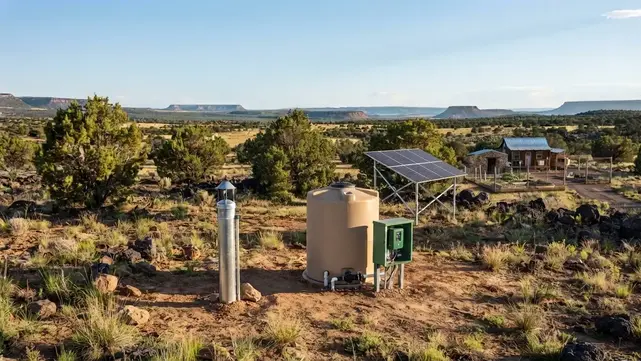
Remote Apache County properties may combine a private well with solar pumping, water storage, pressure equipment, and other infrastructure to create an independent water system.
Water well drilling in Apache County is not the same from one property to the next. The county covers a large area with substantial differences in elevation, terrain, geology, climate, groundwater conditions, road access, and property development. A well that works well for one rural parcel may require a very different drilling and water-system approach on another. Understanding these local conditions before drilling helps property owners make better decisions about well location, access, expected water demand, pump equipment, storage, and future development.
Apache County also contains many large-acreage, remote, and undeveloped properties. In these locations, the well is rarely an isolated project. Its location may need to work with a future house pad, septic system, driveway, electrical service, solar equipment, livestock areas, outbuildings, and water distribution lines. Planning those relationships early can help prevent unnecessary excavation and difficult infrastructure changes later.
Groundwater availability is not uniform across Apache County. Elevation, surface geology, subsurface formations, recharge patterns, and local aquifer conditions can influence where groundwater is encountered and how much water a completed well can produce. A nearby property having a successful well does not necessarily mean another parcel will have the same depth or production. Site-specific evaluation and information from nearby wells can help establish realistic expectations, but actual conditions are confirmed through drilling.
Parts of Apache County contain hard and variable subsurface materials that can affect drilling. Volcanic rock, fractured formations, consolidated material, gravel, cobbles, clay, and other difficult ground conditions may require different drilling methods, tooling, or equipment. These conditions can influence drilling speed, depth, construction methods, and overall project cost.
Apache County properties range from relatively open high-desert terrain to mountainous and forested areas with substantial elevation changes. Elevation affects more than drilling access. Once a well is completed, the vertical lift from the water source to a home, storage tank, or other point of use can affect pump selection, pressure requirements, and overall system design.
A property can be accessible to a passenger vehicle while still presenting challenges for a full-size drilling rig and support equipment. Narrow gates, steep approaches, rough roads, soft ground, tight turns, overhead obstacles, vegetation, and limited staging areas can affect mobilization. Well planning should consider how the drilling equipment will reach the proposed location before the final site is selected.
The most convenient drilling location is not always the best long-term location. The well may need to be considered alongside the future home, septic area, driveway, utility corridors, solar equipment, outbuildings, livestock areas, and drainage. Establishing the general property-development layout before drilling can help reduce conflicts between the well and improvements that are planned later.
Rural properties frequently require both a private well and an onsite septic system. Their locations should be evaluated together because applicable setback, site, soil, and installation requirements can affect where each system can be placed. The exact requirements depend on the property and project, so well and septic planning should be coordinated before final locations are established.
Apache County's summer monsoon season can produce intense rainfall and temporary runoff across rural properties. Stormwater can affect access roads, drilling pads, equipment staging, exposed ground, and the ability to reach a remote well site. Seasonal weather should therefore be considered when planning site access, mobilization, excavation, and related water-system work.
Higher-elevation communities in Apache County can experience significant winter cold and freezing conditions. Above-ground plumbing, pressure equipment, storage, exposed water lines, and pump-system components may require appropriate protection depending on the property and system design. A well can produce water reliably while the overall system still experiences problems if exposed components are not planned for local winter conditions.
A well's production rate and the property's available water storage are separate considerations. A lower-producing well may still support a property when paired with appropriately sized storage and a properly designed pumping system, while a higher-producing well may require a different configuration. Water demand, recovery rate, storage capacity, pump output, and pressure requirements should be considered together rather than relying on a single gallons-per-minute number.
Remote Apache County properties may not have conventional electrical service. In those situations, pumping water can become an important part of the property's overall energy plan. Solar pumping, battery storage, generators, pressure systems, water storage tanks, and backup power may all be considered depending on the well and intended use. The water system and energy system should be planned together rather than treating the pump as an independent component.
On undeveloped acreage, getting a drilling rig to the well location may require more planning than the drilling itself. Existing driveways may be too narrow, rough access roads may need improvement, or vegetation and terrain may restrict equipment movement. In some cases, driveway construction, grading, clearing, or temporary access improvements may need to be coordinated with the drilling project.
On a small developed property, the well location may be obvious. On large Apache County acreage, the proposed homesite may be hundreds or thousands of feet from the property entrance, existing improvements, or other infrastructure. Choosing a well location requires consideration of drilling access, future structures, water-line distance, elevation, septic planning, power requirements, and the property's long-term development pattern.
These conditions are why water well projects in Apache County should be evaluated as property-specific projects rather than based on a generic drilling assumption. Ground conditions, elevation, access, groundwater information, intended water use, well location, pump requirements, storage, septic, and future development can all influence the appropriate approach. Actual groundwater depth and production cannot be guaranteed before drilling, but careful planning can help property owners understand the major factors that will affect their project.
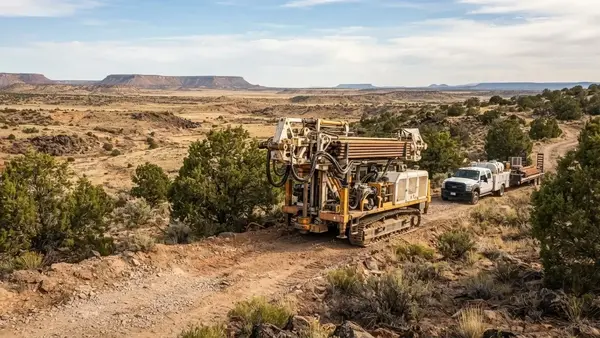
Remote Apache County well sites must provide practical access for the drilling rig, support equipment, materials, and staging required to complete the project.
Understanding the ground beneath an Apache County property is an important part of planning a private water well. Groundwater conditions can change substantially across the county because of differences in elevation, terrain, geology, surface materials, groundwater systems, and local recharge conditions. Well depth, drilling difficulty, water production, and pump requirements should therefore be evaluated for the specific property rather than assuming nearby wells will produce identical results.
Existing well information can provide useful planning context, but a successful well on a neighboring parcel does not guarantee the same depth or production on another property. Actual subsurface conditions can change across relatively short distances. The completed well ultimately determines the actual water level, production, construction requirements, and pumping characteristics of the system.
Valley and basin areas can contain layers of sand, gravel, silt, clay, and other deposited materials. These materials can influence how groundwater moves through the subsurface and where water-bearing zones occur. The thickness, composition, and underlying formations can vary considerably from one property to another.
Parts of Apache County contain volcanic and other consolidated rock formations. Hard ground can affect drilling speed, tooling, equipment requirements, borehole construction, and the depth at which productive water-bearing zones are encountered. Actual drilling conditions determine the appropriate drilling approach.
Groundwater does not occur at one uniform depth throughout Apache County. Elevation, geology, groundwater systems, recharge, and local subsurface conditions can all affect the depth at which water is encountered. Nearby well depths can provide useful context but should not be treated as a guarantee for a new well.
Apache County includes substantial elevation differences between lower desert, plateau, valley, and higher-elevation mountain communities. Elevation matters not only when evaluating groundwater but also when determining how much vertical lift is required to move water from the completed well to a home, storage tank, livestock area, or other point of use.
Rural parcels can range from relatively open high-desert terrain to rolling plateau ground and mountainous or forested properties. Terrain affects drilling access, equipment staging, well placement, water-line routing, and the relationship between the well and future improvements.
Different subsurface layers can behave very differently during drilling. Clay, sand, gravel, silt, and mixed sediments can affect borehole stability, drilling methods, casing requirements, and water-bearing characteristics. The sequence and thickness of these materials are ultimately confirmed during drilling.
In some hard-rock environments, groundwater may occur within fractures or other permeable zones rather than within a thick, uniform aquifer. The location and connectivity of these zones can influence well depth and production. This is one reason geological information can help with planning without guaranteeing a particular drilling result.
Groundwater systems are influenced by precipitation, infiltration, snowmelt in higher elevations, surface drainage, and other recharge processes. Apache County covers a large geographic area with different terrain and precipitation patterns, making the property's specific location important when evaluating groundwater conditions.
Higher-elevation portions of Apache County can experience freezing temperatures and significant winter weather. While the well itself is underground, exposed water lines, pressure equipment, storage systems, and other components may require appropriate freeze protection depending on the property's elevation and system design.
On large rural parcels, the distance between the well and future improvements can become a major planning consideration. Longer water lines can affect trenching, pressure, pumping requirements, installation cost, and access. The best well location should therefore consider both groundwater information and the property's long-term development layout.
Existing well records can provide useful information about historical drilling depths, water levels, construction, and production in an area. These records are valuable planning resources, but they describe individual wells and cannot guarantee identical conditions on a different parcel. They should be considered alongside other property-specific information.
Well production depends on the water-bearing formation, completed well construction, water level, pumping conditions, and other factors. Two wells in the same general area can produce different amounts of water. The final water-system design should therefore be based on the actual production of the completed well rather than an assumed gallons-per-minute rate.
For Apache County landowners, groundwater planning should begin with the property's exact location, intended use, anticipated water demand, proposed well location, and long-term development plans. A full-time residence, seasonal cabin, ranch, livestock operation, and off-grid homesite may require very different water-system configurations.
Apache County does not have one universal well depth, drilling method, or expected production rate. Local well information, geological conditions, terrain, access, intended water use, and professional evaluation can help establish realistic expectations before drilling. Actual groundwater conditions and completed well production must ultimately be determined through the drilling and testing process.
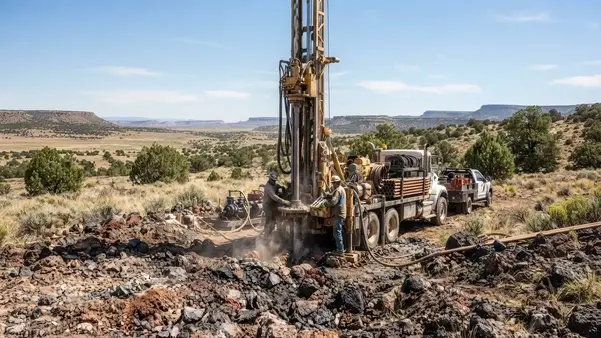
Apache County properties can contain significantly different subsurface materials, including sediment, gravel, volcanic rock, and harder formations that can affect drilling methods and well construction.
Water well requirements vary depending on the property, intended water use, groundwater conditions, and how the well will connect to the rest of the development. Rural homes, cabins, ranches, livestock properties, and off-grid parcels can each require a different combination of drilling, pumping, storage, and distribution equipment.
The goal is to match the well and supporting water system to the property's actual needs rather than assuming every Apache County property requires the same setup. Property access, future construction, water demand, and available groundwater should all be considered when planning the system.
Private wells can provide household water for rural homes where municipal service is unavailable. System planning considers expected household demand, well production, pump capacity, pressure requirements, and the location of the future home and utilities.
Cabins and seasonal properties may have different water demands than full-time homes. Well planning can account for seasonal occupancy, winter conditions, equipment access, freeze protection, and whether the property may eventually become a full-time residence.
Remote properties may require a water system independent of municipal infrastructure. Depending on the property, this can include solar pumping, storage tanks, pressure equipment, battery or generator backup, and water lines connecting the well to the home.
Ranch properties may need water for homes, livestock, barns, shops, and other improvements. Higher or variable demand can make well production, pump capacity, storage, and distribution especially important for the overall property water system.
Groundwater depth can vary considerably across Apache County, and surface conditions cannot reliably predict the final well depth. Actual drilling conditions and available groundwater information help determine the depth and construction requirements of the completed well.
Storage tanks can supplement a well where production or daily demand makes additional capacity useful. Tanks can be combined with pumps and pressure systems to provide a more consistent supply during periods of higher household, ranch, or off-grid demand.
Whether you are developing a rural homesite near St. Johns, building a cabin in the White Mountains, establishing a ranch property, or planning an off-grid parcel farther from existing infrastructure, the water system should be matched to the actual property and its intended use. Well depth, production, pump equipment, storage, access, and future development all need to work together rather than being treated as separate decisions.
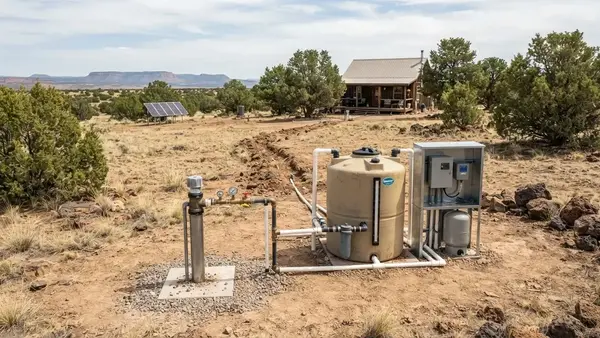
A completed private well becomes a usable water supply only after the well, pump, pressure equipment, storage, power, and distribution system are properly coordinated.
One of the first questions Apache County landowners ask when planning a private well is, "How deep will we have to drill, and will we actually get enough water?" Those are important questions, but there is no single well depth or production rate that applies across the county. Apache County includes broad high-desert basins, mountain terrain, valleys, mesas, volcanic areas, sedimentary formations, and other geologically different environments. Groundwater conditions can therefore change considerably between properties, and sometimes between nearby parcels.
A good well-planning decision starts with the information that is available before drilling and then adjusts to what the drill rig actually encounters underground. Existing well records, nearby drilling information, property elevation, local geology, intended water use, access, and the planned development can all help establish realistic expectations. None of those factors, however, can guarantee the exact depth or production of a new well before it is drilled and tested.
For a rural Apache County property owner, the goal should not simply be to find water. The goal is to develop a water source and delivery system that produces enough water, at an appropriate rate, for the way the property will actually be used.
For Apache County landowners, the most useful way to think about a private well is as a complete water-supply system rather than simply a drilled hole. Expected depth, groundwater conditions, well production, water levels, pump capacity, storage, pressure, water quality, access, septic placement, and future construction can all influence the final result. Good planning cannot eliminate the uncertainty inherent in drilling, but it can help you understand the property, establish realistic expectations, and make better decisions before major money is committed to the project.
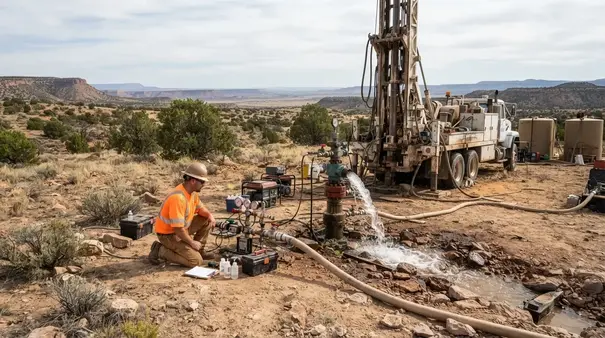
Well depth and water production are determined by actual subsurface conditions and testing rather than by a countywide average or the results of a nearby property.
Well depth and water production are two of the biggest concerns for Apache County landowners, but neither can be guaranteed from a countywide average or a neighboring property's results. The most useful starting point is to look at the specific property, available nearby well information, intended water use, drilling access, geology, and planned development.
If you're considering a private well for a home, cabin, ranch, livestock operation, or off-grid property, we can connect you with water well drilling professionals who can discuss your property and help you understand the next steps before drilling begins.
Call (928) 543-6447Drilling a successful water well is only the beginning of the water-supply system. The completed well still needs equipment capable of lifting water, maintaining usable pressure, handling the property's expected demand, and operating reliably under the conditions found at the site. Pump and delivery equipment should be selected from the actual characteristics of the completed well rather than from well depth alone.
Well depth, static and pumping water levels, production, elevation, daily demand, pressure requirements, storage needs, available power, and the intended use of the property can all influence the final system. A pump configuration suitable for a small cabin may be very different from the system required for a full-time residence, ranch, livestock operation, or larger rural property.
Submersible pumps operate below the water level and push groundwater toward the surface. Pump capacity should be matched to the completed well's depth, water level, production, pressure requirements, and expected demand.
Pressure tanks, switches, controls, and related equipment help provide consistent water pressure at the property's fixtures. Sizing depends on the pump, household demand, pressure settings, and overall water-system configuration.
A lower-producing well may still support a practical water system when storage is properly incorporated. Storage allows water to accumulate between periods of demand instead of requiring the well to match peak household consumption.
Elevation changes affect how much work the pumping system must perform. Water that must travel uphill from the well to a home, storage tank, or other improvement may require additional pumping capacity and careful pressure planning.
Remote Apache County properties may use solar power to operate well equipment. Solar pumping can be paired with water storage and appropriate controls to provide water where conventional electrical service is unavailable.
A private well depends on powered pumping equipment, making backup power important for some rural properties. Generators, batteries, solar systems, or combinations of these can help maintain water availability during electrical interruptions.
Higher-elevation areas of Apache County can experience significant winter cold. Exposed water equipment, tanks, lines, and related components may require appropriate freeze protection based on the property's elevation and system design.
Ranch properties may need water delivered to multiple locations rather than a single residence. Pump capacity, storage, distribution equipment, and livestock watering points should be considered when designing the system.
Pumps, pressure equipment, tanks, controls, and related components eventually require inspection or service. Practical equipment placement can make future maintenance easier, particularly on remote acreage where access may already be difficult.
Water lines carry water from the well and pumping equipment to the home, cabin, storage tank, livestock area, shop, or other improvements. On large rural properties, line distance, elevation changes, trenching conditions, access, and future development should be considered when planning the distribution route.
A dependable well system should be designed around the completed well and the property's actual water requirements. Well production, water levels, elevation, pressure, storage, power availability, winter conditions, water-line routing, and intended use all influence the appropriate pump and delivery equipment.
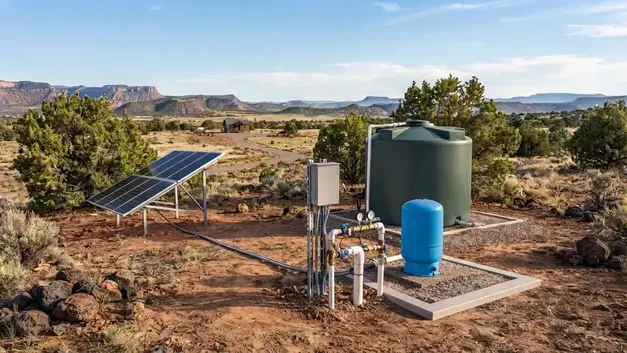
A properly planned rural water system can combine a private well, pumping equipment, storage, pressure controls, and solar power to support a remote Apache County property.
An off-grid water system is more than a private well. Remote Apache County homes, cabins, ranches, and undeveloped properties may need to combine a water source, storage, pumping, pressure equipment, power, and distribution into one coordinated system.
The right configuration depends on the property's well production, elevation, water demand, available power, distance between improvements, and plans for future development. The goal is to design the water system as a connected network rather than installing each component independently.
A private well can provide the primary water source for an off-grid home, cabin, ranch, or rural property where municipal water service is unavailable or impractical.
Storage can provide reserve capacity and help separate the timing of water production from periods of higher household, ranch, or livestock demand.
Solar power can operate well pumps and related equipment on remote properties without conventional electrical service, particularly when combined with adequate water storage.
Batteries, generators, or other backup systems can provide additional operating flexibility when solar production or normal electrical service is unavailable.
Pumps, pressure equipment, storage, and distribution piping work together to move water from the source to the property's actual points of use.
The water system can be coordinated with the future house pad, driveway, septic area, utility routes, and other improvements before finished site work is completed.
For remote Apache County properties, reliable water independence comes from coordinating the source, storage, pumping, power, pressure, and distribution system around the property's actual needs. Planning these components together can make future homes, cabins, ranch facilities, and other improvements easier to support and expand.
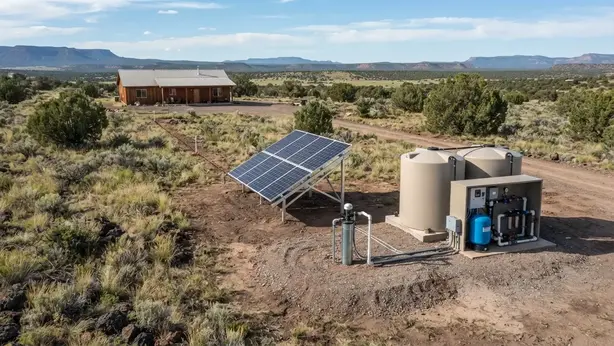
Off-grid water systems coordinate the well, storage, pumping, power, and distribution infrastructure needed to serve remote homes, cabins, and rural properties.
Drilling a private well is not always the first water decision an Apache County landowner needs to make. Some properties are still in the planning stage, some owners need water during construction, and others may be dealing with uncertain groundwater conditions, limited electrical infrastructure, or long distances from established services. In these situations, a properly planned storage or supplemental water system can provide a practical path forward while the permanent water strategy is developed.
The important question is not simply whether an alternative water source exists. The system needs to make sense for the property's location, access, occupancy, water demand, available power, storage capacity, future well plans, and intended use. A temporary solution for a weekend cabin can look very different from a long-term water system supporting a full-time residence, ranch, livestock operation, or larger off-grid development.
Delivered water can provide an immediate source for properties that are not yet connected to a permanent water system. A properly sized storage tank gives the property a reserve while allowing water to be hauled in as needed. This can be especially useful during early construction, temporary occupancy, or the planning stage before drilling.
Above-ground tanks can support construction sites, cabins, ranch properties, and developing off-grid homesites. Tank capacity should be based on actual water use, delivery frequency, available equipment, freeze exposure, and how the stored water will ultimately be pumped and distributed.
Cistern systems can provide substantial stored water where hauling and storage are part of the property's long-term plan. Depending on the design, a cistern can feed pumps, pressure equipment, filtration, and household distribution lines, creating a usable water system without depending on continuous well production.
Rainwater collection can supplement another water source by capturing runoff from suitable roof areas. On rural Apache County property, the system may require storage, filtration, first-flush equipment, and appropriate plumbing depending on the intended use. Rainwater is generally better considered as part of a broader water strategy than as an automatic replacement for a private well.
A property may need water before the permanent home, well, septic system, or utilities are completed. Temporary tanks and delivered water can support construction activities while the permanent infrastructure is being developed. Planning temporary access and tank placement early can prevent unnecessary disturbance to finished site work.
Remote properties without conventional electrical service can combine stored water with solar-powered pumping and pressure equipment. This approach can be useful when water must be moved between a storage tank, home, livestock area, or other improvements without relying entirely on utility power.
A lower-producing well does not automatically mean the property cannot have a practical water system. Where appropriate, storage can allow water to accumulate between periods of use and then supply the property during higher-demand periods. The actual well production and daily demand determine whether this approach is practical.
Some Apache County properties are developed over months or years rather than all at once. A landowner may begin with delivered water and storage, establish access and a homesite, and later transition to a permanent well, pump, and distribution system. Planning the phases together can reduce duplicated work and unnecessary excavation.
The best water solution depends on what the property needs today and where the property is headed tomorrow. A remote Apache County parcel may begin with a water tank during construction, transition to a cistern or storage-based system, and eventually incorporate a private well with solar pumping and permanent distribution. Evaluating the water strategy alongside the future house pad, septic area, driveway, solar equipment, utility routes, livestock areas, and other improvements can help prevent expensive changes after the property has already been developed.
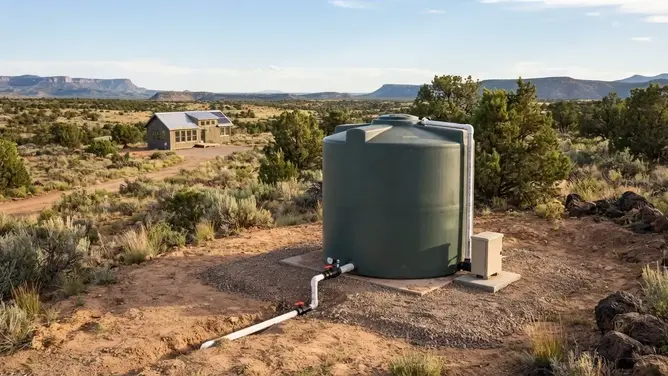
Water storage tanks and cistern systems can provide reserve capacity for developing rural properties, construction sites, cabins, and off-grid homesites.
Whether you're considering a private well, water storage, a cistern, delivered water, solar pumping, or a phased off-grid water system, the right approach depends on the property's location, access, expected water demand, available power, and long-term development plans. Planning those components together can help avoid unnecessary excavation and infrastructure changes later.
Call (928) 543-6447Drilling a water well is easier to plan when the well is considered part of the property's overall development from the beginning. Before scheduling drilling, landowners should have a basic understanding of how the property will be used, where major improvements are likely to go, and what infrastructure the completed well may need to support.
You do not need every future building completely designed before investigating a well. However, establishing the general development plan early can help prevent the well from becoming an obstacle to future construction or requiring expensive infrastructure changes later.
Establish the general location of the future residence, cabin, manufactured home, or primary occupied structure. The relationship between the homesite and well can affect water-line length, trenching, pumping requirements, access, and future site work.
Identify the likely septic area before permanently establishing the well layout. The well, wastewater system, residence, drainage features, property boundaries, and usable building area may all compete for space on a rural homesite.
Consider how drilling equipment will reach the property and proposed drilling area. Private roads, gates, slopes, vegetation, soft ground, turning areas, and staging space can all affect whether a location is practical for drilling.
Decide whether the eventual water system is likely to use utility electricity, solar, batteries, a generator, or a combination of power sources. Pumping requirements should be considered alongside the property's overall energy plan.
Determine whether the property may benefit from a storage tank or cistern. Storage can provide reserve capacity, support lower-producing wells, and make some off-grid pumping configurations more practical.
Consider which future improvements may need water, including a home, cabin, shop, barn, greenhouse, or livestock area. Identifying likely water corridors early can reduce unnecessary excavation through completed roads, pads, or landscaping.
A raw parcel can appear to have unlimited space, but the usable area becomes much more constrained once a homesite, septic system, driveway, utilities, drainage, solar equipment, and future structures are considered.
Before committing to a drilling location, coordinate the proposed well with the property's intended use and have applicable setbacks, permitting, well construction, and septic requirements confirmed by the appropriate Arizona authorities and qualified professionals.
One of the most important questions landowners ask before buying or developing rural property is simple: how deep will the water well need to be? The difficult part is that there is no single well depth that accurately represents Apache County. Groundwater conditions can change between properties, and nearby wells are useful reference points rather than guarantees for a new drilling location.
Apache County contains a wide range of terrain and geological settings. A property near St. Johns, Springerville, Eagar, Concho, Sanders, the White Mountains, or the Navajo Nation area can have very different site conditions from another parcel elsewhere in the county. Elevation, geology, existing well information, groundwater conditions, and the intended use of the property all matter.
Well depth is property-specific. A nearby well may provide useful historical information, but it should not be treated as a promise that a new well will encounter water at the same depth or produce the same quantity of water.
Rock type, fractured formations, sedimentary layers, volcanic material, and other subsurface conditions can influence drilling difficulty and the formations encountered during construction.
Finding groundwater is only part of the question. The completed well also needs to produce enough water for the intended use. A residence, weekend cabin, ranch, livestock operation, and larger rural development can have very different water demands.
Existing well records can provide useful context about nearby drilling depths, water levels, well construction, and reported uses. They are most useful when interpreted as regional evidence rather than as a guarantee for a specific parcel.
Elevation differences across rural property can affect both groundwater expectations and the eventual pumping system. Elevation also matters after drilling because lifting water uphill requires additional pumping energy and system planning.
Water quantity and water quality are separate questions. A well that produces water may still require testing and, depending on the results and intended use, filtration, treatment, or other water-system components.
If you are evaluating raw land, be cautious of statements such as “water is always at 200 feet here” or “the neighbor hit water at this depth, so yours will too.” Existing well information can be valuable, but subsurface conditions are not perfectly uniform. A professional evaluation should consider the actual parcel, available records, geology, intended use, and applicable requirements before drilling decisions are made.
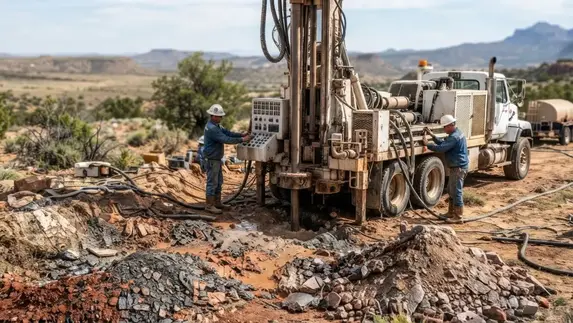
Groundwater conditions and subsurface geology can vary significantly between Apache County properties, making nearby well records useful reference information rather than a guarantee of depth or production for a new well.
Water well drilling in Apache County is subject to Arizona groundwater and well construction requirements. The exact authorization, filing, registration, reporting, and construction requirements can depend on the type of well, its location, the intended use, and whether the property falls within an area subject to additional groundwater-management requirements.
Landowners should not assume that the requirements for one Arizona property automatically apply to another. Before drilling begins, the proposed well should be reviewed against current Arizona Department of Water Resources requirements and any other applicable federal, state, tribal, or local requirements affecting the property.
Arizona has a formal well-drilling authorization process. Depending on the property, well type, location, and intended use, a Notice of Intent or other authorization may be required before drilling begins. The applicable filing should be confirmed with the Arizona Department of Water Resources and the licensed well driller before equipment is mobilized to the property.
ADWR provides the current online filing system and information for applicable Notices of Intent to Drill. Requirements can change, so property owners should verify the current process before scheduling the project.
The proposed well location should be evaluated in relation to the property's legal description, boundaries, existing wells, septic system, buildings, roads, utilities, drainage features, and applicable setbacks. The location also needs to provide practical access for the drilling equipment and future maintenance of the well.
On undeveloped Apache County property, well placement should be coordinated with the future house pad, driveway, septic area, electrical or solar infrastructure, water storage, and underground water lines. A location that works for drilling today should also make sense for the property's long-term development plan.
Water well construction is regulated work. Arizona's well authorization and reporting processes involve licensed well drilling professionals, and the appropriate driller should be selected before the project is scheduled. The driller can help identify the applicable construction and filing requirements for the proposed well.
Completed wells are documented through Arizona's well reporting and registration system. Well construction information can include the well location, depth, casing, construction details, water levels, and other information required by the applicable reporting process.
A private water supply well and onsite wastewater system need to be planned together. Applicable wastewater rules establish separation requirements involving private wells, while the actual site layout may require additional consideration based on terrain, drainage, property boundaries, and the proposed wastewater system.
Requirements can vary depending on where a property is located and how the well will be used. Rural residential, agricultural, livestock, commercial, monitoring, and other well types may have different regulatory considerations. The project should therefore be reviewed based on the actual parcel rather than a generic county-wide assumption.
Arizona Department of Water Resources provides the state's current information regarding well drilling authorization, Notices of Intent, well registration, drilling forms, reporting, and related groundwater requirements.
Because requirements can depend on the well type, location, intended use, and applicable groundwater-management rules, property owners should verify the requirements that apply to their specific project before drilling begins.
Visit the Arizona Department of Water Resources Well Drilling Authorization Page
Permitting and regulatory review should happen before drilling equipment arrives on the property. Confirming the applicable well authorization, location requirements, construction requirements, reporting obligations, and related septic or site requirements early can help prevent avoidable delays and changes to the planned water system.
Once the property's general development plan is understood, the next question is where the well itself should be located. Well siting involves more than finding an open area where a drilling rig can fit. The location needs to work for drilling, the completed water system, required setbacks, maintenance access, and the property's surrounding improvements.
A well location that looks convenient from a property map can become problematic if it creates a difficult water-line route, conflicts with the septic area, blocks future construction, or cannot be reached by drilling equipment. The proposed location should therefore be evaluated from both the drilling and long-term operating perspectives.
The well location should be evaluated in relation to the septic system and other potential sources of contamination. Applicable Arizona requirements include separation requirements for private water supply wells, so the proposed well and wastewater areas should be reviewed together before final siting.
Avoid placing the well where a future house, cabin, shop, barn, or other improvement could restrict access to the wellhead or interfere with maintenance and future construction.
Evaluate the actual route from the property entrance to the proposed well location. Gates, road width, turning space, grades, vegetation, surface conditions, and staging requirements can all affect whether the drilling equipment can reach the site.
A well located far from the primary water-use area may require a substantially longer underground water line. Longer runs can increase trenching, material requirements, maintenance considerations, and pumping demands.
The completed well may require electrical service, solar equipment, batteries, controls, or another power source. The well location should be considered in relation to the property's planned power and utility infrastructure.
Natural drainage, concentrated runoff, erosion, washes, slopes, and areas where water collects should be considered when evaluating the drilling location. Surface conditions can affect both construction access and the long-term condition of the well area.
Meeting a minimum setback does not automatically make a well location the best location for the property. A technically compliant site can still create a poor water-line route, difficult drilling access, conflicts with future improvements, or unnecessary maintenance challenges.
For example, Arizona onsite wastewater requirements include setback provisions involving public or private water supply wells. Exact requirements depend on the applicable rules and project conditions and should be verified for the specific property before construction.
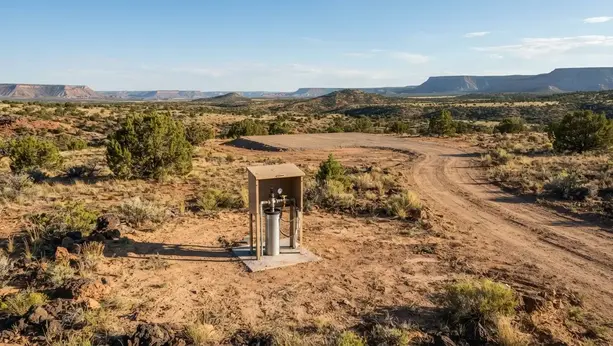
Well placement should account for drilling access, the future homesite, water-line routing, septic planning, terrain, drainage, and long-term maintenance access.
Well placement needs to account for more than minimum setbacks. The proposed location may also need to work with drilling access, the future homesite, septic area, water-line routing, power infrastructure, drainage, and long-term maintenance access.
Call (928) 543-6447A private water well is one component of a larger rural development project. Once the general well location has been established, the next step is coordinating the water system with the property's construction sequence. House pads, septic systems, driveways, utilities, solar equipment, drainage, and future structures all need to work around the completed water infrastructure.
This becomes especially important on large Apache County parcels where improvements may be separated by hundreds of feet or more. Planning the order of construction and the major infrastructure corridors early can reduce duplicated excavation and help keep completed areas from being disturbed later.
Confirm the proposed well location based on groundwater considerations, applicable requirements, drilling access, and the property's overall layout. The final location becomes the starting point for coordinating the rest of the water infrastructure.
Plan the driveway and other primary access routes needed for drilling, construction, and future maintenance. Establishing access early can prevent finished improvements from becoming obstacles to equipment movement.
The future building area should be considered in relation to the well and water distribution route. This helps establish where the completed water system will need to connect with the residence and surrounding site improvements.
The well, residence, septic system, and surrounding site conditions should be planned together. The final wastewater layout may affect usable building space and the routing of other utilities across the property.
Plan logical routes for water lines, electrical service, communications, and other utilities before major grading and finished site work are completed. Coordinated corridors can reduce repeated trenching across the same areas.
Off-grid properties may use solar, batteries, generators, or combinations of power sources. The location of power equipment and the route to the well should be considered alongside the water system's pumping and storage requirements.
Determine how water will move from the well or storage system to the primary home and any reasonably foreseeable additional water-use areas. Planning these routes before finished construction can reduce future excavation.
If the property may eventually include a cabin, shop, barn, livestock area, greenhouse, or other permitted improvement, consider whether the water infrastructure can reasonably accommodate future expansion without relocating major components.
Rural properties are often developed in phases rather than all at once. A landowner may establish access first, drill the well, install power and water infrastructure, prepare the homesite, construct the residence, and add additional improvements later.
Thinking about the construction sequence before major excavation begins can help keep water lines, utility corridors, access routes, and future building areas coordinated. The objective is not to predict every future improvement, but to avoid obvious conflicts between the infrastructure being installed today and the property that will be developed tomorrow.
Project-specific setbacks, permitting, engineering, well construction, septic, electrical, plumbing, and installation requirements should be confirmed with the appropriate Arizona authorities and qualified professionals.
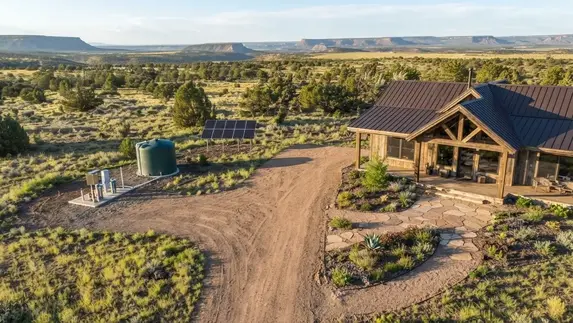
Coordinating the well, homesite, access, water distribution, power, septic area, and future improvements early can reduce conflicts as a rural Apache County property is developed in phases.
Getting a drilling rig onto rural property can be a project of its own. Many Apache County parcels are large, undeveloped, or reached by private roads that were never designed for heavy drilling equipment. Before scheduling a well, landowners should evaluate the entire route from the public road to the proposed drilling location.
Rough or poorly maintained roads can become difficult for heavy equipment, especially after rain, snow, or periods of saturated ground. The route should be evaluated for width, grade, surface condition, and turning areas.
Gate openings, fencing, cattle guards, narrow entrances, and property access points can limit equipment movement. The drilling contractor should know about access restrictions before mobilization.
Juniper, pinyon, ponderosa pine, brush, and other vegetation can affect access to remote drilling locations. Clearing requirements depend on the actual route and equipment involved.
Steep approaches, uneven ground, rocky surfaces, washes, and abrupt grade changes can complicate equipment movement. Terrain should be considered before the drilling date rather than discovered during mobilization.
Drilling operations require practical space for equipment, materials, workers, and drilling-related activities. A cramped site can make an otherwise reachable location impractical.
Weather can change rural access conditions quickly. Snow, monsoon rainfall, mud, runoff, and freeze-thaw conditions may affect roads and work areas depending on the property's elevation and location.
A parcel may have a perfectly suitable drilling location that is difficult to reach. When evaluating a remote property, think about the entire access chain: public road, private road, gate, driveway, terrain, clearing, turning area, staging area, and final well location.
Identifying access problems early can help avoid last-minute grading, vegetation removal, gate modifications, or other site work immediately before drilling.
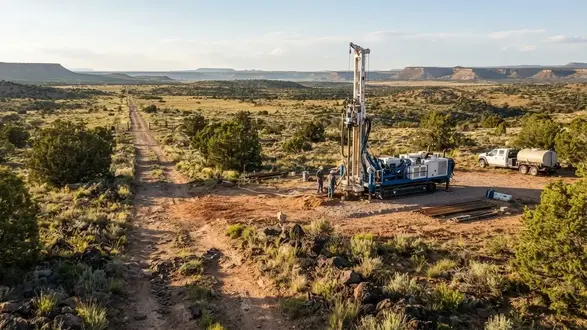
Remote Apache County well projects require more than a suitable drilling location. Roads, gates, terrain, vegetation, staging areas, and equipment access all need to work together before drilling begins.
Landowners who have never drilled a private well may not know what happens between the initial property evaluation and a functioning water system. The exact process varies by property and well type, but understanding the major stages makes it easier to plan access, scheduling, site work, and the infrastructure that follows drilling.
The project begins with the property's location, intended water use, available access, development plans, existing infrastructure, and applicable requirements.
Applicable Arizona well requirements, drilling authorization, registration, construction requirements, and project-specific considerations should be confirmed before drilling begins.
Drilling equipment is brought to the property using the planned access route. Remote sites may require additional preparation depending on road, terrain, gate, and staging conditions.
Drilling progresses through the subsurface formations encountered at the property. Actual conditions can influence drilling speed, equipment requirements, materials, and final well construction.
Depending on the well, construction can involve casing, sealing, well development, testing, and other work necessary to establish the completed well according to applicable requirements.
The completed well may then be integrated with a pump, pressure equipment, storage, electrical or solar power, treatment equipment, and water distribution lines.
A landowner should budget and plan for the infrastructure that comes after drilling. Depending on the project, the completed system may still require pumping equipment, electrical or solar power, pressure controls, storage, treatment, underground water lines, and connections to the intended structures.
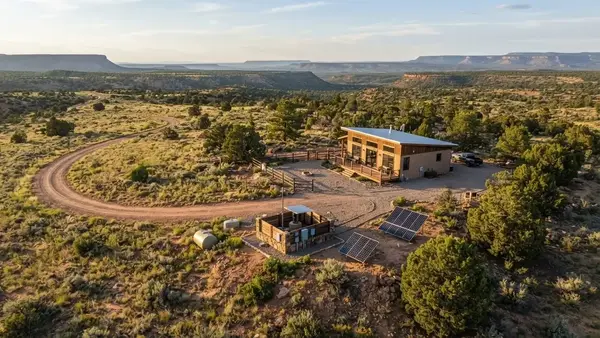
A private well is often one component of a larger rural development plan, connecting the water source with the future homesite, access road, power system, storage, and other property improvements.
Drilling a private water well is only the beginning of developing a usable water source. After a well is drilled on rural property in Apache County, Arizona, the completed water system may still require well development and testing, a properly sized well pump, power, pressure equipment, water storage, treatment or filtration, and an underground water line to the home or other permitted water-use areas.
The equipment needed after well drilling depends on the completed well, water level, expected production, water quality, elevation, distance to the building site, daily water demand, available electricity, and whether the property is connected to the electrical grid or being developed as an off-grid home, cabin, ranch, or rural homesite. On larger Apache County properties, the well and the rest of the private water system should be planned together rather than treating the wellhead as the end of the project.
After drilling, the well may need to be developed and tested to establish how the completed well performs. Information such as well depth, static water level, pumping conditions, production rate, and water characteristics helps determine the appropriate equipment. A private well pump should be selected for the actual well and the property's expected water demand rather than simply choosing a pump based on well depth alone.
A rural water well needs a reliable way to power its pumping equipment. Depending on the property, a well pump may operate from utility electricity, an off-grid solar system, batteries, a generator, or a combination of power sources. Solar-powered well pumping can be particularly useful for remote Apache County properties without conventional electrical service, but the solar array, batteries, controls, and pump should be sized around the actual well and expected water demand.
A water storage tank or cistern can provide reserve capacity between periods of well production and periods of household or property demand. Storage can be especially useful for low-yield wells, off-grid homes, remote cabins, ranch properties, and properties where water demand may temporarily exceed the well's pumping rate. Tank capacity, placement, elevation, access, and refill requirements should be considered as part of the complete rural water system.
A private well pump and pressure tank work together with pressure controls, switches, piping, and other equipment to deliver usable water pressure throughout the property. The system must account for the well's production, pump characteristics, building elevation, line length, fixture demand, and other water uses. On larger or sloped Apache County properties, elevation changes between the well, storage tank, home, and other buildings can affect pressure and pumping requirements.
A newly drilled well may be located some distance from the future home, cabin, shop, manufactured home, livestock facility, or other permitted structure. An underground water line can connect the well or storage system to those water-use locations. The water-line route should be planned around the house pad, driveway, septic area, electrical utilities, drainage, property grades, and future construction so that a finished site does not have to be excavated again later.
Having water in a completed well does not automatically mean the water is ready for every intended use. Appropriate water testing can identify characteristics that may affect household use, treatment requirements, or system design. Depending on the results and intended use, a private well may require filtration, disinfection, water treatment, or other equipment before water is distributed to household fixtures.
One of the most important distinctions for a raw-land buyer is the difference between having a drilled well and having a functioning private water system. A well may still need a pump, power source, pressure tank, storage, treatment equipment, controls, and underground water piping before it can reliably supply a home or other improvements.
For an off-grid property in Apache County, the complete system may also need to coordinate with solar panels, batteries, generators, cisterns, water storage tanks, long underground water lines, and significant elevation changes across the property. Planning these components together can help avoid installing equipment that is undersized, inaccessible, or poorly positioned for future development.
Before construction begins, property owners should have the completed well characteristics, intended water use, equipment requirements, applicable regulations, and site-specific installation requirements evaluated by the appropriate qualified professionals. The right configuration for a remote cabin can be very different from the water system needed for a full-time residence, ranch, livestock operation, or multi-structure rural property.
If you are developing raw land in Apache County, the well should be considered one component of the property's larger water infrastructure plan. Coordinating the well pump, power, storage, pressure system, water treatment, underground water lines, house pad, septic area, driveway, and future building locations before major site work can make the completed property easier to use, maintain, and expand.
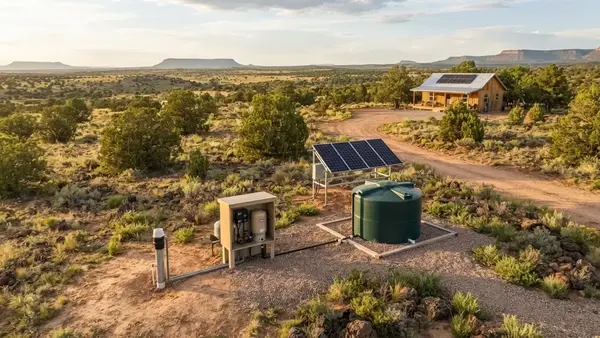
A completed rural water system can combine the well, pump, power source, storage, pressure equipment, treatment, and underground water lines into one coordinated system.
A drilled well may still need a properly sized pump, power source, pressure equipment, storage, water treatment, and underground water lines before it can serve a home or other permitted water-use areas. For rural and off-grid Apache County properties, these components should be considered together with the site's elevation, water demand, access, and future development plans.
Call (928) 543-6447We connect rural property owners with water well drilling and private well professionals throughout Apache County, Arizona. Our service area supports homeowners, cabin owners, ranchers, landowners, livestock operators, manufactured home owners, and off-grid property owners who need a dependable private water source. Well projects may include new well drilling, well pumps, private water systems, well-to-house water lines, and related water infrastructure based on the property's location, groundwater conditions, intended water use, access, and development plans.
If your property is located anywhere in Apache County or the surrounding rural communities, we can help connect you with a water well professional who can evaluate your property's location, access, groundwater considerations, and intended water use. Well drilling requirements can vary significantly across the county, particularly on large acreage, remote homesites, ranch properties, and undeveloped or off-grid parcels. Your well project should be evaluated according to the property's specific conditions and applicable Arizona requirements rather than assuming the same drilling approach will work everywhere.
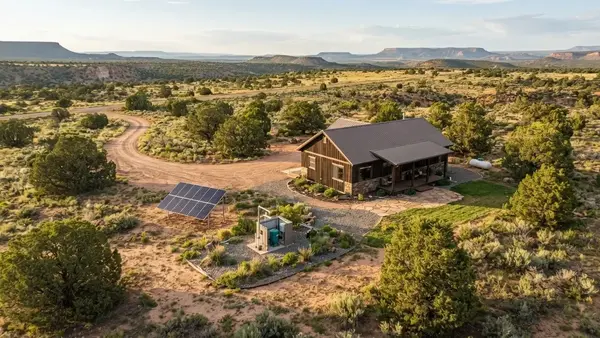
Thoughtful well planning allows water infrastructure to support the larger vision for a remote Apache County homesite, cabin, ranch, or off-grid property.
Developing rural property in Apache County often requires a dependable private water source. Water well projects involve more than drilling a hole in the ground. Well location, expected groundwater conditions, geology, access, drilling depth, pump requirements, water-system design, permitting, and the property's future development plans can all affect the project. The answers below address common questions about private water wells and rural water systems throughout Apache County, Arizona.
Get your rural property evaluated for the water well and private water-system requirements needed to support your planned development. Whether you are building a site-built home, manufactured home, cabin, ranch residence, livestock property, or off-grid homesite, a successful well project involves more than drilling alone. Well location, drilling access, groundwater considerations, pump requirements, power, storage, pressure equipment, underground water lines, septic placement, and future building locations should all be considered as part of the property's larger development plan. Contact Apache County Land Services to discuss your property and get connected with qualified water well professionals who can evaluate the site's location, access, intended water use, and project requirements.
Call (928) 543-6447