 Apache County Land Services
Off-Grid Solar • Battery Storage • Rural Energy Systems • Property Development
Connect With Local Solar Professionals
(928) 543-6447
Apache County Land Services
Off-Grid Solar • Battery Storage • Rural Energy Systems • Property Development
Connect With Local Solar Professionals
(928) 543-6447⭐ Off-Grid Solar Installation • Solar Power Systems • Battery Storage • Rural Energy Systems • Solar Solutions Across Apache County Arizona
Need reliable off-grid power for your rural property? Apache County Land Services connects property owners with experienced solar installation and renewable energy professionals for homes, cabins, ranches, manufactured homes, recreational properties, and remote off-grid developments throughout Apache County. Get connected for off-grid solar power systems, solar panel installation, battery energy storage, inverters, system planning, and related electrical infrastructure based on your property's location, energy needs, available sunlight, access, existing utilities, and long-term development plans.
Connecting property owners with solar professionals serving St. Johns, Concho, Vernon, Sanders, Springerville, Eagar, Alpine, Greer, Nutrioso, McNary, Ganado, Window Rock, and surrounding Apache County communities.
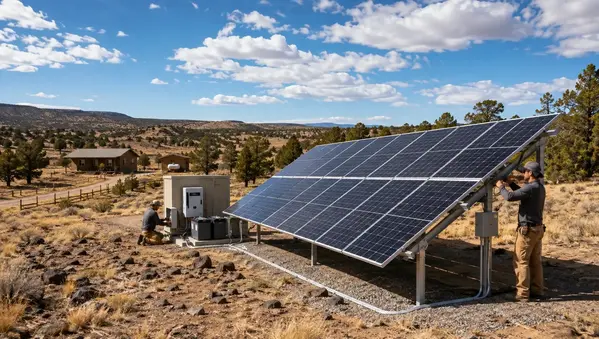
Off-grid solar in Apache County is more than installing photovoltaic panels and connecting a battery. A dependable independent power system has to be designed around the property's actual electrical demand, available solar exposure, battery-storage requirements, equipment locations, access conditions, and the way the property is expected to be developed and used. Those considerations become especially important on remote acreage where utility power may not be available and the solar system may become the property's primary source of electricity.
Rural properties throughout Apache County can have dramatically different power requirements. A seasonal cabin in the White Mountains may have modest electrical demand, while a full-time residence near Concho or St. Johns may need to operate refrigeration, water heating, HVAC equipment, well pumps, pressure systems, appliances, communications equipment, and other continuous or high-demand loads. A ranch, workshop property, manufactured home, or remote recreational parcel may introduce an entirely different combination of electrical loads.
The solar array is only one component of the complete system. Battery storage, inverters, charge controllers, disconnects, electrical panels, wiring, grounding, mounting structures, monitoring equipment, and potentially backup generation all have to function together. On undeveloped Apache County land, those electrical components also need to be coordinated with the future homesite, private well, septic system, driveway, utility corridors, drainage improvements, RV area, workshop, barn, and other planned improvements. Before buying rural land in Apache County, these infrastructure requirements should be considered as part of the property's overall development plan.
A practical solar design therefore begins with the property rather than with a predetermined number of panels. Before installation, the intended electrical loads, solar array location, battery capacity, equipment placement, access, terrain, future construction, and periods of reduced solar production should be considered together. This approach can help property owners avoid designing a system that works for today's limited setup but becomes inadequate when the property is developed further.
Important considerations when planning an off-grid solar system for an Apache County property include:
For remote Apache County properties, the most useful solar plan is one that considers the entire property rather than treating the photovoltaic array as an isolated installation. The future home, well, septic system, driveway, drainage, utility corridors, outbuildings, equipment locations, access routes, and expected electrical loads can all influence where solar infrastructure belongs and how the system should be configured.
Property owners should also understand that electrical design, equipment selection, structural requirements, permitting, inspections, and installation must follow the requirements applicable to the specific project. Qualified solar and electrical professionals should evaluate the site and establish the final system design. Apache County Land Services helps property owners begin that process by connecting the broader rural development plan with the solar and electrical professionals needed for the project.
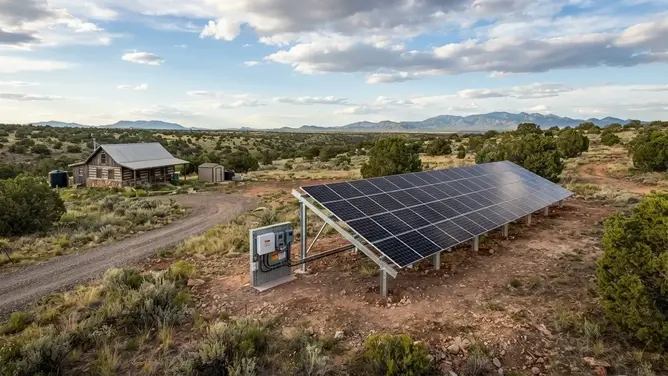
Off-grid solar systems on rural Apache County properties must be planned around the property's electrical loads, terrain, access, water system, buildings, and future development.
Off-grid solar solves a different infrastructure problem on rural Apache County property than it does on a conventional subdivision lot. A remote parcel may be far from existing utility infrastructure, separated from established development by long distances, or intentionally planned as an independent homesite, cabin, ranch, or recreational property. In those situations, solar has to be evaluated as part of the property's complete power system rather than as a simple panel installation.
The most important question is not simply how many solar panels can fit on the property. The system needs to produce enough energy for the property's actual electrical loads, store usable energy for periods when solar production is unavailable, convert that energy into usable electricity, and distribute power safely to the buildings and equipment that depend on it. The right configuration can be very different for a seasonal cabin, full-time residence, manufactured home, ranch, RV property, or undeveloped homesite.
Apache County also presents substantial variation in elevation, terrain, vegetation, weather exposure, property size, accessibility, and development patterns. A system designed for one rural parcel should not automatically be assumed appropriate for another. Professional solar planning should begin with the actual property, intended use, electrical demand, available solar exposure, equipment locations, access conditions, and future development plans.
A full-time rural residence can place substantially greater demands on an off-grid power system than a seasonal property. Refrigeration, lighting, communications, appliances, water heating, HVAC equipment, electronics, well pumps, and other household loads should be evaluated together when determining the required generation, storage, and inverter capacity.
A cabin used only on weekends or during certain seasons may have lower overall consumption, but its electrical demand can still change dramatically when occupied. Refrigeration, pumps, heating, lighting, communications, cooking equipment, and recreational loads should be based on the actual pattern of use rather than simply assuming that occasional occupancy requires a minimal solar system.
Rural ranch properties can have electrical loads distributed across a much larger area than a conventional homesite. Water pumps, livestock systems, agricultural equipment, communications, security systems, workshops, barns, storage buildings, and other outbuildings may all need to be incorporated into the overall power plan.
Undeveloped Apache County acreage provides an opportunity to plan solar before roads, buildings, wells, septic systems, and other permanent infrastructure are installed. Establishing the intended power strategy early can help reserve appropriate space for solar equipment, batteries, electrical distribution, and future off-grid land development.
Solar system capacity should be based on the property's expected electrical demand. Major appliances, HVAC, water heating, refrigeration, pumps, tools, electronics, lighting, and outbuilding loads should be identified before the system is sized. Understanding which loads operate continuously and which operate intermittently can materially affect the design.
Batteries allow energy produced during periods of solar generation to remain available after the sun goes down or production temporarily falls. Storage planning should consider nighttime demand, critical loads, expected solar production, desired reserve, battery operating conditions, and how much autonomy the property owner expects from the system.
The amount of usable sunlight available at the actual array location matters more than simply knowing that the property receives abundant sunshine. Trees, structures, terrain, seasonal shading, vegetation, orientation, and future construction can influence the amount of usable solar exposure available to the system.
Rural properties throughout Apache County can include open ground, slopes, rocky areas, forested terrain, uneven surfaces, and elevated locations. Ground-mounted solar may therefore require site evaluation for grading, mounting conditions, drainage, vegetation, rock, equipment access, and the practical working area available around the proposed array.
Solar equipment can be surprisingly difficult to deliver to a remote parcel when access roads are narrow, steep, rough, gated, soft, or poorly established. Panels, batteries, mounting components, electrical equipment, and construction machinery all need a practical route to the installation area. Access should be evaluated before equipment is scheduled for delivery.
A private well can become one of the most important electrical loads on an off-grid property. Pump horsepower, starting demand, operating cycles, pressure equipment, controls, and water-storage equipment can influence the required inverter, battery, and generation capacity. The well should therefore be included in the solar load assessment rather than treated as a separate project.
Not every septic system requires substantial electrical power, but some onsite wastewater systems include pumps, controls, alarms, or other powered components. Where those systems are part of a fully off-grid property, their electrical requirements should be identified during solar planning so essential wastewater equipment remains compatible with the independent power system.
A rural property can accumulate electrical loads as development progresses. A shop may eventually add compressors, welders, tools, lighting, or heating equipment, while barns and agricultural buildings may require lighting, pumps, communications, or other electrical service. Planned outbuildings should be considered before the initial solar system is finalized.
Off-grid power planning becomes more practical when essential loads are distinguished from discretionary ones. Water pumping, refrigeration, communications, security, essential lighting, and critical equipment may receive priority over workshops, electric heating, large tools, or other high-demand loads. Establishing those priorities can help professionals develop a more useful energy strategy.
Ground-mounted solar can be an attractive option on rural acreage where sufficient open land is available. It can provide flexibility in array placement when a roof is shaded, poorly oriented, structurally unsuitable, or reserved for another purpose. The selected area still needs to work with terrain, drainage, vegetation, access, mounting requirements, and electrical routing.
Roof-mounted panels can make efficient use of an existing or planned structure when the roof has suitable orientation, available area, structural characteristics, and solar exposure. On rural property, however, the roof should be evaluated alongside the property's broader development plan rather than automatically assuming it is the best location for the solar array.
Rural properties are frequently developed in stages. An owner may initially use an RV or small cabin and later construct a permanent home, install a larger well system, add a shop, build a barn, or introduce additional electrical equipment. Discussing likely future loads early can help determine whether the initial solar infrastructure should accommodate later expansion.
For rural Apache County property owners, the strongest solar strategy is usually the one designed around the entire property rather than the solar array alone. Electrical demand, battery storage, solar exposure, well pumping, septic equipment, access, terrain, equipment locations, buildings, outbuildings, and future development can all influence the final system. Planning these elements together can help create an off-grid power system that is better matched to how the property will actually be used.
An off-grid solar installation is an interconnected electrical system rather than simply a collection of photovoltaic panels. Solar generation, battery storage, inverters, electrical distribution, protection equipment, and backup power all work together to provide usable electricity for a rural property.
The equipment configuration depends on how the Apache County property will be used and what the system needs to operate. A seasonal cabin may require a relatively small system, while a full-time residence with a private well, HVAC equipment, appliances, workshops, and multiple buildings can require substantially more generation and storage capacity.
Understanding the major components can help property owners evaluate an off-grid solar proposal and understand how the individual pieces fit into the larger property infrastructure plan.
Photovoltaic panels convert sunlight into electrical energy for the property. Array size depends on expected electrical demand, available solar exposure, panel output, seasonal production, and the selected installation location.
Batteries store usable energy produced by the solar array for nighttime operation and periods of reduced solar production. Storage capacity should be matched to electrical demand, critical loads, reserve requirements, and desired autonomy.
Inverters convert and manage electrical power so the solar and battery system can supply the property's AC loads. Capacity should account for normal consumption and applicable startup demands from pumps, appliances, tools, and other equipment.
Charge controllers regulate electricity moving from the solar array into compatible battery storage. The appropriate equipment depends on the array, battery technology, system configuration, and specifications of the selected components.
Distribution equipment delivers power to the property's buildings and electrical loads. Panels, breakers, disconnects, conduit, wiring, and related equipment are configured around the system design and applicable electrical requirements.
Off-grid systems require appropriate equipment to control, isolate, and protect electrical circuits and system components. Grounding, overcurrent protection, disconnects, and other protective equipment are part of the overall installation.
Solar panels, batteries, inverters, buildings, wells, and other loads must be connected through properly planned electrical pathways. On large rural parcels, equipment locations and wiring distances can affect installation complexity.
Some off-grid properties use a generator as supplemental power during extended periods of low solar production or unusually high demand. Backup generation can provide additional resilience when maintaining dependable power is important.
Monitoring and control equipment can help track solar production, battery condition, electrical consumption, and system operation. Visibility into system performance can help property owners and service professionals identify changing power needs or potential operating issues.
An off-grid solar system should be designed as a complete power system rather than selecting each component independently. Solar generation, battery storage, inverter capacity, electrical distribution, protection equipment, wiring, and backup power all need to match the property's actual electrical requirements.
This is especially important on rural Apache County properties where the system may also need to support a private well, septic equipment, HVAC, outbuildings, workshops, or future development. Planning those loads early can help create a more practical and expandable off-grid power system.
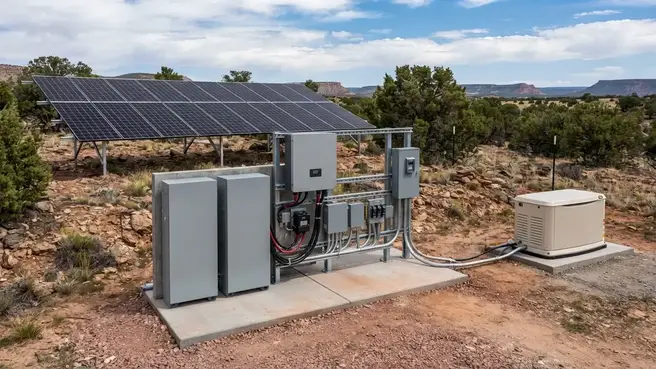
An off-grid solar system combines photovoltaic generation, battery storage, inverters, electrical distribution, protection equipment, monitoring, and backup power into one coordinated system.
Whether you are developing a full-time residence, cabin, ranch, manufactured home, recreational property, or remote homesite, the solar system should be matched to the property's actual electrical requirements. Apache County Land Services can help you connect with qualified solar and electrical professionals and coordinate the power plan with your well, septic system, driveway, buildings, utility routes, and future improvements.
Discuss Your PropertyOne of the most important decisions in an off-grid solar project is determining what the system actually needs to power. Panel count alone does not determine whether a system can reliably support a rural property. Solar planning should account for everyday consumption, high-demand equipment, startup loads, and electrical needs that may be added in the future.
Rural properties can have very different electrical demands depending on how they are used. A seasonal cabin may have relatively modest loads, while a full-time residence, ranch, workshop, or off-grid homesite may require substantially more power for water pumping, heating, cooling, appliances, tools, communications, and other equipment.
Before system capacity is finalized, the major electrical loads should be identified and considered together. This gives the solar and electrical professionals a better basis for evaluating generation, battery storage, inverter capacity, and overall system configuration.
Important electrical loads to consider include:
A reliable off-grid power system has to account for more than how much electricity the solar array can produce on an ideal day. Daily consumption, peak demand, equipment startup requirements, battery storage, seasonal production, and future electrical loads all influence the appropriate system design.
Solar planning on rural Apache County land is influenced by the property itself. Elevation, slope, vegetation, rock, weather exposure, access, existing improvements, and future development can all affect where equipment can be installed and how the system should be configured.
These conditions do not automatically prevent solar installation, but they can influence the preferred array location, mounting approach, equipment placement, access requirements, trenching, and site preparation. Evaluating these factors early can help the solar system fit the property rather than forcing the property to accommodate the equipment.
Slopes, elevation changes, and uneven terrain can affect array placement, mounting, access, drainage, trenching, and ground-mounted installation options.
Juniper, piñon pine, ponderosa pine, oak, brush, and other vegetation can create shading or restrict access to otherwise suitable solar installation areas. Where vegetation interferes with the planned array or access route, land clearing may be part of the site preparation process.
Rock and difficult ground conditions can affect mounting foundations, equipment pads, trenching and site excavation, conduit routes, and required site preparation.
Higher-elevation properties may require additional consideration for snow exposure, winter access, temperatures, equipment locations, and seasonal maintenance.
Long drives, narrow routes, gates, uneven ground, and limited staging areas can affect delivery and installation of solar equipment on remote rural properties.
Array placement should account for actual sunlight, orientation, shading, terrain, nearby structures, and changes that could affect future solar production.
Natural drainage paths, washes, and areas subject to runoff should be considered when selecting locations for arrays, equipment, access routes, and electrical infrastructure.
Homes, cabins, driveways, wells, septic systems, outbuildings, and existing utilities can limit available space and influence the overall solar system layout.
Future homes, shops, barns, garages, utility corridors, and other improvements should be considered as part of the property's long-term off-grid development plan so new development does not interfere with the solar installation.
A solar system that works well on one Apache County property may require a different layout or installation approach on another. Evaluating terrain, solar exposure, access, vegetation, existing infrastructure, and future development first can help determine where the system should actually go.
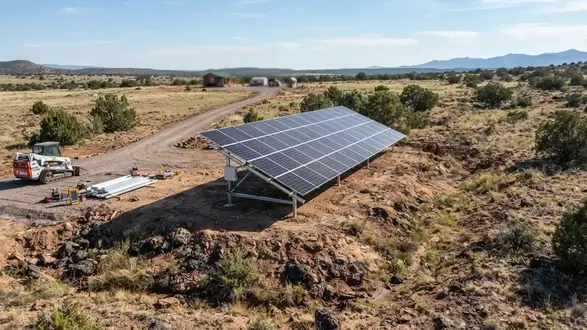
Ground-mounted solar placement can be influenced by Apache County Arizona terrain, vegetation, rock, drainage, solar exposure, access, and future property improvements.
Solar should not be planned in isolation when an Apache County parcel is being developed from raw land. The solar array and electrical equipment need to coexist with the property's water system, wastewater system, buildings, roads, drainage, and underground utilities. Coordinating these systems early can help prevent expensive conflicts later.
This is especially important on remote properties where several infrastructure projects may be completed in stages. Establishing the overall property layout before construction begins can help determine where solar equipment, utility corridors, access routes, and future improvements should be located.
Well pumps can be significant electrical loads on an off-grid property. Pump locations, water storage, pressure equipment, controls, and solar capacity should be considered together when planning the property's independent water system and power systems.
Some septic systems include pumps, alarms, controls, or other powered equipment. Those electrical requirements should be identified during solar planning so essential wastewater infrastructure remains compatible with the property's independent power system.
Solar equipment should be positioned so it does not interfere with permanent driveways, turnarounds, equipment access, or future road improvements. Access routes should also remain usable for maintenance and future property development.
Conduit routes between solar arrays, buildings, batteries, wells, and other electrical loads should be considered before utility trenches are installed. Coordinating utility corridors early can help reduce unnecessary excavation and future disruption.
Future homes, cabins, and manufactured homes should be considered when selecting solar array and equipment locations. Planning around the intended building footprint can help prevent shading, access problems, or relocation of solar infrastructure later.
Shops, barns, garages, pump houses, and other outbuildings can introduce additional electrical loads as the property develops. Their planned locations should be considered when determining solar generation, equipment placement, and electrical distribution.
Solar arrays, equipment pads, and access routes should be planned around natural drainage, runoff patterns, washes, and areas where water could affect the installation. Site drainage and grading should remain functional after solar construction is completed.
Solar planning should account for future construction, equipment access, livestock areas, fencing, additional buildings, and other planned improvements. Treating solar as part of the larger off-grid property development plan can help reduce conflicts as the parcel evolves.
On undeveloped Apache County acreage, solar is only one part of the infrastructure plan. Coordinating the future house pad, driveway, well, septic system, utility corridors, drainage, outbuildings, and solar equipment before major construction can help reduce unnecessary excavation, relocation, and site disturbance.
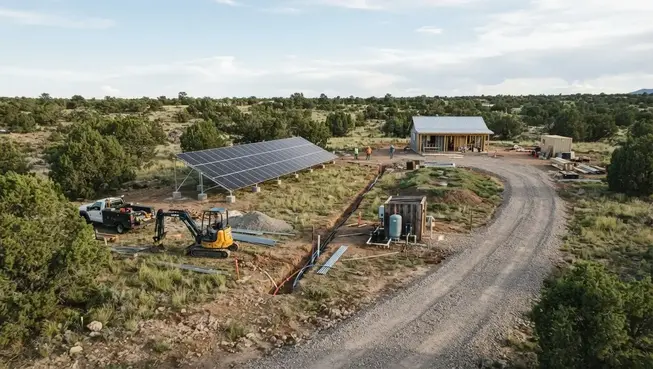
Off-grid solar is part of the larger rural property infrastructure plan, including the well, septic system, driveway, buildings, utility corridors, drainage, and future improvements.
Rural Apache County properties often give property owners more flexibility in choosing where solar equipment is installed. Depending on the property, a roof-mounted array may be practical, while a ground-mounted system may provide better access, solar exposure, or flexibility. The appropriate approach depends on the building, terrain, shading, access, electrical routing, and long-term development plan.
Neither mounting approach is automatically better for every rural property. The available roof area, structural condition, ground conditions, vegetation, future buildings, driveway layout, and location of electrical equipment should all be considered before the final array location is selected.
Roof-mounted panels can use existing building space without occupying additional ground area. Roof condition, orientation, available space, structural suitability, shading, electrical routing, and future roof work should all be considered.
Ground-mounted arrays can provide more flexibility when a roof is shaded, poorly oriented, structurally unsuitable, or limited in available space. They may also provide easier physical access for inspection and maintenance.
The best mounting location is the one that provides suitable usable sunlight over time. Trees, terrain, structures, orientation, seasonal shading, and future improvements can all affect the amount of solar exposure available to the array.
Juniper, piñon pine, ponderosa pine, oak, brush, and other vegetation can affect both roof and ground-mounted systems. Existing vegetation and potential future growth should be considered when selecting the array location.
Ground-mounted systems may require vegetation removal, grading, excavation, structural support, drainage planning, or electrical trenching. The amount of preparation depends on the site's terrain, soil, rock, and installation requirements.
Slopes, rocky ground, uneven surfaces, washes, and elevation changes can affect where a ground-mounted array can be installed. Site conditions should be evaluated before selecting the mounting location and installation approach.
Solar equipment needs practical access for installation, inspection, repairs, and future maintenance. Ground-mounted systems may simplify physical access, while roof-mounted systems can reduce the amount of additional ground infrastructure required.
Solar placement should account for future homes, cabins, shops, barns, driveways, septic systems, wells, utilities, and other improvements. Choosing the mounting location as part of the larger property plan can help avoid future conflicts.
For rural Apache County properties, the best solar mounting option depends on the actual property rather than a one-size-fits-all approach. Roof condition, solar exposure, terrain, vegetation, access, electrical routing, ground conditions, and future development should all be considered when determining whether roof-mounted or ground-mounted solar is the better fit.
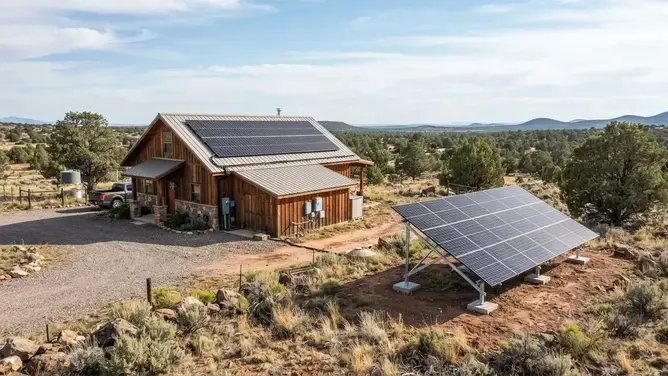
Rural Apache County properties may accommodate roof-mounted or ground-mounted solar depending on solar exposure, building conditions, terrain, access, electrical routing, and future development.
Roof-mounted and ground-mounted solar can each make sense depending on the property. Apache County Land Services can help you connect with qualified solar and site-development professionals who can evaluate solar exposure, terrain, vegetation, access, electrical routing, building conditions, and future development before the final array location is selected.
Call (928) 543-6447For a genuinely off-grid property, solar production during daylight hours is only part of the power equation. Electricity may still be needed after sunset, during storms, during periods of reduced solar production, or when electrical demand temporarily exceeds the array's available output.
Battery storage and backup power can provide additional flexibility by allowing the property to use stored energy when solar production is unavailable or insufficient. The appropriate storage and backup strategy depends on the property's electrical loads, solar production, desired level of independence, and critical equipment.
Battery storage allows electricity produced during the day to remain available after sunset. This helps support household loads when the solar array is no longer actively generating power.
Cloud cover, storms, snow, and other conditions can temporarily reduce solar production. Adequate storage can provide additional energy during periods when generation is lower than expected.
Properties relying on electric well pumps need dependable power for water production. Storage planning should account for pump operation, startup demand, and other critical water-system equipment.
Essential loads can be prioritized when available energy is limited. Water systems, refrigeration, communications, security, and essential lighting may receive priority over discretionary electrical equipment.
Some off-grid properties incorporate a generator as an additional backup source. Generator integration can provide another layer of resilience during extended periods of low solar production or unusually high electrical demand.
Rural properties often gain electrical loads as development continues. Future homes, shops, wells, outbuildings, and equipment should be considered when planning battery storage and inverter capacity.
Battery storage should be planned around the property's actual electrical demand and desired level of energy independence. Solar production, nighttime consumption, critical loads, well-pump requirements, backup generation, and future electrical needs can all influence the appropriate storage strategy.
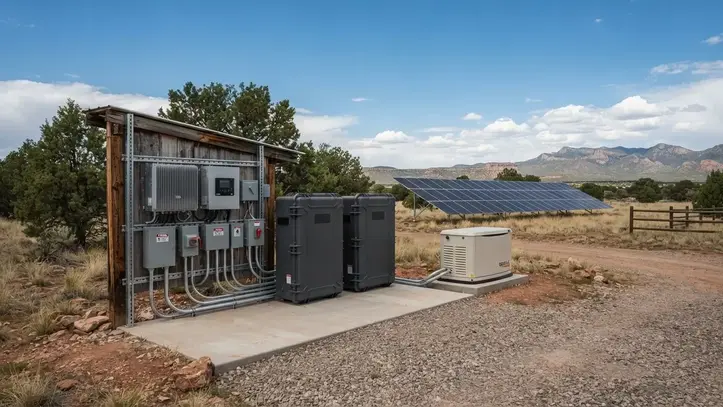
Battery storage and backup generation can help an off-grid Apache County Arizona property maintain essential electrical service when solar production is reduced or demand increases.
Developing an off-grid solar system on rural Apache County property involves more than selecting panels and batteries. The property's intended use, electrical demand, solar exposure, terrain, access, equipment locations, well, septic system, buildings, and future improvements should all be considered before installation begins.
Determine whether the property will support a full-time home, seasonal cabin, manufactured home, ranch, recreational property, RV setup, or another use. Occupancy and intended use provide an important starting point for estimating electrical demand.
Identify the appliances, HVAC equipment, refrigeration, lighting, electronics, well pumps, tools, outbuildings, and other electrical equipment the system may need to support. Critical and high-demand loads should also be identified early.
Potential array locations should be evaluated for usable sunlight, orientation, shading, vegetation, terrain, structures, and seasonal conditions. The largest open area is not necessarily the best location for solar generation.
Review slopes, rocky ground, vegetation, drainage, available working space, and other physical conditions that may affect mounting, equipment placement, access, trenching, and required site preparation.
Confirm practical access for delivering panels, batteries, mounting equipment, electrical components, and construction materials. Remote roads, gates, steep grades, narrow routes, and limited staging areas can affect installation planning.
Determine practical locations for the solar array, batteries, inverters, disconnects, electrical panels, and other system components. Equipment placement should work with the property's buildings, access routes, terrain, and future development.
Account for private well pumps, pressure equipment, septic pumps, alarms, controls, water storage, and related infrastructure when developing the electrical plan. These systems should work together rather than being treated as separate projects.
Establish electrical conduit routes, equipment areas, mounting locations, and any required grading, vegetation removal, excavation, or trenching. Planning these improvements together can reduce unnecessary disturbance later.
Qualified solar and electrical professionals can finalize the system design and address applicable permitting and installation requirements. Approved equipment and infrastructure can then be installed according to the project specifications.
Complete applicable inspections, testing, configuration, commissioning, and system verification before normal operation begins. The completed system should be checked to ensure its components operate together as intended.
One of the biggest planning mistakes on raw rural property is selecting a solar location without considering the rest of the development. A seemingly ideal array location may later conflict with a driveway, house pad, well, septic system, utility corridor, drainage improvement, shop, barn, or other permanent feature.
A better approach is to treat solar as one part of the property's overall infrastructure plan. The electrical system, water supply, wastewater system, access, buildings, drainage, utility routes, and future improvements should be considered together before major construction begins.
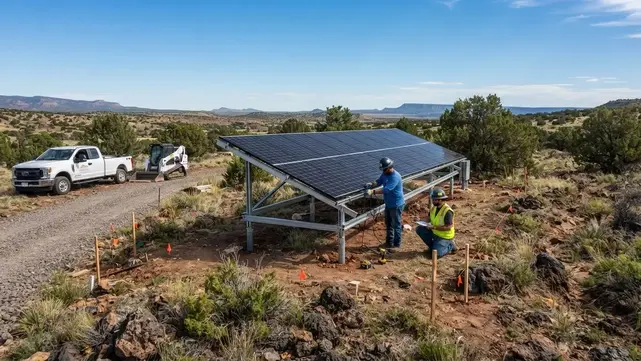
Solar array placement should account for sunlight, terrain, drainage, vegetation, access, electrical routing, and the property's future development.
One of the most expensive mistakes on undeveloped rural land is designing today's infrastructure without considering tomorrow's property. An Apache County parcel may begin with an RV, small cabin, or limited power requirement and eventually become a full-time residence with a private well, septic system, shop, garage, greenhouse, livestock facilities, or additional buildings.
Planning the solar system alongside the property's future development can help reserve appropriate space for generation, batteries, electrical equipment, access routes, and future expansion before permanent improvements make those decisions more difficult.
Important future-development considerations include:
The goal is not necessarily to install a larger solar system than the property currently requires. Instead, the property should be planned so today's solar infrastructure does not unnecessarily limit tomorrow's development. Considering the future home, well, septic system, driveway, outbuildings, utility corridors, and expected electrical loads together can make later expansion much easier to coordinate.
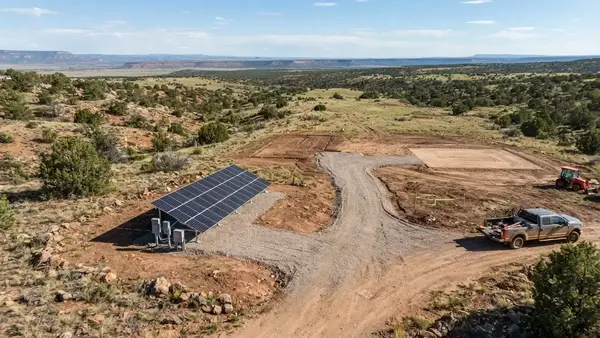
Off-grid solar should be positioned as part of the property's larger development plan, leaving practical space for future buildings, roads, wells, septic systems, and expansion.
If your property will eventually include a home, well, septic system, driveway, shop, barn, RV site, or other improvements, solar should be planned as part of the overall property layout. Apache County Land Services can help coordinate the broader development plan with qualified solar, electrical, excavation, well, septic, access, and other infrastructure professionals.
Call (928) 543-6447Many off-grid solar problems begin before installation. Rural property owners can unintentionally create expensive complications by selecting equipment or installation locations before understanding the property's electrical requirements, terrain, access, infrastructure, and future development. Careful planning can help avoid problems that become much more difficult to correct after construction begins.
Common mistakes to avoid when planning an off-grid solar system for an Apache County property include:
Avoiding these mistakes starts with treating solar as part of the property's overall infrastructure rather than as a standalone panel installation. Electrical demand, battery storage, solar exposure, terrain, access, well pumping, septic equipment, buildings, utility routing, and future development should all be considered before permanent equipment locations are established.
The final electrical system should be evaluated and designed by qualified solar and electrical professionals according to the requirements applicable to the specific property and installation. Apache County Land Services helps property owners connect their broader rural development plans with the appropriate solar and electrical professionals for the project.
The right off-grid solar configuration depends on how a property will be used, how much electricity it requires, and how the site is expected to develop. A seasonal cabin, full-time residence, ranch, manufactured home, recreational property, or undeveloped rural parcel can each require a different approach to solar generation, battery storage, electrical distribution, and equipment placement.
Apache County property owners may also have to account for private wells, septic systems, remote access, variable terrain, outbuildings, workshops, RV use, and future construction. Planning the solar system around the property's actual use can help create a more practical independent power system while leaving room for future development and changing electrical requirements.
Off-grid solar for a full-time rural home requires detailed electrical load planning for refrigeration, appliances, lighting, HVAC, water heating, communications, and private well equipment. Battery storage, inverter capacity, and solar generation should be matched to the home's expected daily and peak electrical demand.
An off-grid cabin may have lower overall electricity consumption than a permanent residence, but seasonal occupancy can create significant changes in demand. Solar planning should consider heating, refrigeration, lighting, water systems, communications, battery storage, and the possibility of eventually expanding the cabin or property.
Ranch solar power systems may need to serve electrical loads spread across a large rural property. Private wells, livestock systems, pumps, workshops, barns, security equipment, communications, and other outbuildings should be considered when planning solar generation, battery storage, and electrical distribution.
Off-grid solar for a manufactured home should account for the home's electrical service, HVAC equipment, appliances, water heating, occupancy, and private water infrastructure. The solar system also needs to work with the property's driveway, septic system, utility routing, equipment locations, and other permanent site improvements.
Rural recreational properties and RV sites may require solar power for intermittent occupancy, lighting, refrigeration, communications, water pumps, security equipment, and other smaller electrical loads. Planning the system around actual RV and recreational use can provide useful power without overlooking future property needs.
Undeveloped Apache County acreage provides an opportunity to plan off-grid solar before major construction begins. Solar equipment can be coordinated with future roads, grading, building pads, private wells, septic systems, utility corridors, outbuildings, and additional electrical infrastructure from the beginning.
Whether the property is a full-time homesite, seasonal cabin, ranch, manufactured home, recreational parcel, or undeveloped acreage, off-grid solar should be planned around the property's actual electrical requirements and long-term development goals. Apache County Land Services can help property owners coordinate the broader site-development plan with the solar, electrical, water, wastewater, access, and infrastructure professionals needed to complete the project.
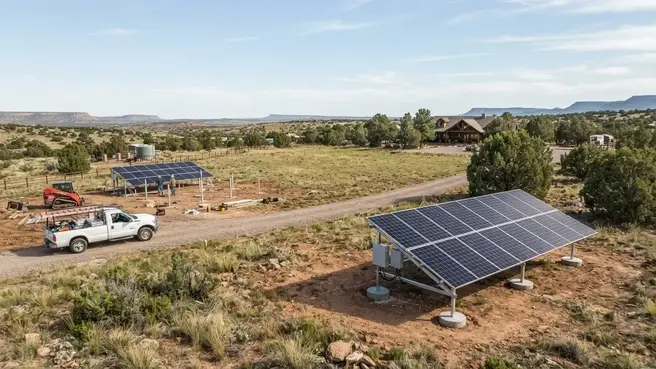
A properly planned initial solar installation can preserve space and access for additional solar generation and battery capacity as the property develops.
Planning an off-grid solar system on rural Apache County land involves more than choosing photovoltaic panels and a battery bank. The property owner needs to understand where the solar array will go, how much electricity the property will actually require, where the batteries and inverter equipment will be located, how electrical power will reach the buildings and equipment, and how the solar system will fit within the property's broader development plan.
This becomes especially important when the property is still undeveloped. A landowner may be planning a private well, septic system, driveway, house pad, RV area, cabin, manufactured home, shop, barn, or other improvements at the same time as the solar installation. If the solar array, battery equipment, or underground electrical routes are selected too early without considering those improvements, the property may eventually require unnecessary relocation, additional trenching, grading, or reconstruction.
Solar permitting and electrical requirements can also depend on the specific project, equipment, installation method, property use, and applicable jurisdictional requirements. Rather than assuming that every rural solar installation follows the same process, property owners should have the proposed system evaluated and confirm the applicable requirements before construction begins.
Important solar planning and project-coordination considerations for Apache County properties include:
Before equipment is purchased, identify the property's intended use, proposed system type, electrical service configuration, installation location, and applicable approval requirements. Confirming the project requirements early can prevent an owner from purchasing equipment that does not fit the final installation or electrical design.
Solar panels are only one part of an independent power system. Generation, batteries, inverters, disconnects, electrical panels, conductors, grounding, controls, and other components need to be designed to work together. The electrical design should also reflect the property's actual loads rather than relying on a generic system size.
A rural home can have very different energy requirements depending on HVAC, water heating, refrigeration, cooking equipment, appliances, communications, pumps, tools, and occupancy. High-starting-current equipment such as well pumps and compressors should be identified because peak demand can affect inverter and battery requirements.
Battery capacity should be evaluated around nighttime consumption, critical loads, expected solar production, periods of reduced generation, desired reserve, and the property's operating pattern. Storage planning is particularly important when the property depends entirely on its independent power system rather than using utility electricity as a fallback.
The largest open area on a rural parcel is not automatically the best solar location. Array placement should consider solar exposure, shading, slope, terrain, vegetation, drainage, property access, electrical distance, future construction, and the amount of usable working space required around the installation.
Ground-mounted solar may encounter slopes, rock, uneven terrain, native vegetation, drainage features, and difficult excavation conditions. These factors can affect site preparation, mounting methods, equipment access, trenching, and the practical cost and complexity of preparing the selected solar area.
Solar panels, batteries, mounting components, electrical equipment, and construction machinery all need a practical route to the installation area. On remote Apache County property, gates, narrow roads, steep grades, rough surfaces, soft ground, and limited turning space can affect equipment delivery and future service access.
The distance between the solar array, battery bank, inverter equipment, primary structure, well, pump equipment, and outbuildings should be considered before final site work begins. Establishing practical electrical corridors early can reduce unnecessary trenching and help coordinate underground infrastructure with the rest of the property.
When a property depends on a private well, the pump becomes part of the power-system planning rather than a completely separate project. Pump horsepower, starting demand, pressure equipment, controls, water storage, and the distance between the well and electrical equipment can all influence the overall solar and electrical strategy.
Some onsite wastewater systems include pumps, controls, alarms, or other electrical components that require dependable power. The septic area also occupies permanent portions of the property, so its location should be coordinated with the solar array, electrical corridors, future buildings, driveway, well, and other infrastructure.
A solar installation should not consume the most practical location for a future home, cabin, or manufactured home simply because that area is currently undeveloped. The building footprint, construction access, utility connections, drainage, and expected relationship to the solar equipment should be considered before the array location is finalized.
Shops, barns, garages, pump houses, guest cabins, greenhouses, and agricultural structures can add electrical demand after the initial solar installation is complete. Identifying likely future buildings can help determine whether electrical distribution, equipment locations, and available solar capacity should allow for later expansion.
Solar equipment, access routes, equipment pads, and associated site work should be evaluated in relation to natural drainage, runoff, washes, low areas, and existing grades. Changing drainage around a solar installation can create problems elsewhere on the property, particularly when roads and building areas are developed later.
Ground-mounted solar may involve clearing, grading, excavation, foundations or mounting preparation, and underground electrical work. These activities should be sequenced with driveway construction, building-pad preparation, utility trenching, well installation, septic work, and other excavation so completed improvements are not unnecessarily disturbed.
Batteries, inverters, disconnects, controls, and other electrical equipment need locations where qualified professionals can safely inspect, maintain, troubleshoot, and eventually replace them. Equipment placement should account for service access, environmental exposure, security, wiring distances, and the property's future layout.
Applicable permitting, electrical, structural, inspection, and other requirements should be confirmed for the specific solar project before installation. The final system should be designed and installed according to the requirements applicable to the property, equipment, installation method, and jurisdiction.
One common mistake on raw rural land is purchasing panels, batteries, or other equipment before determining how the property will actually be developed. A system may appear appropriately sized on paper but still create problems if the array occupies the future building area, the electrical run is unnecessarily long, the equipment cannot be easily accessed, or the well and other major loads were never included in the original plan.
A better approach is to establish the property's development layout first and then have qualified solar and electrical professionals determine the appropriate system design. The future home, private well, septic system, driveway, drainage, utility corridors, outbuildings, solar array, battery storage, and electrical loads should be considered as connected pieces of the same rural infrastructure plan.
For Apache County landowners, good solar planning starts well before panels arrive at the property. Understanding the site's terrain, solar exposure, electrical demand, access, future construction, water and wastewater infrastructure, equipment locations, and applicable project requirements can make the installation easier to coordinate with the rest of the property. Apache County Land Services helps landowners organize the broader site-development picture so the appropriate solar, electrical, excavation, well, septic, and other professionals can work from a more coordinated plan.
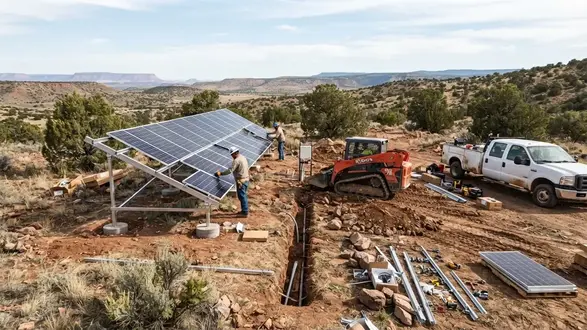
Ground-mounted solar may require coordinated site preparation, equipment access, mounting work, excavation, and underground electrical routing.
If you are developing rural Apache County property, solar may need to be coordinated with permitting, electrical work, site preparation, access, a private well, septic system, utility corridors, buildings, and future improvements. Apache County Land Services can help organize the broader development plan and connect you with qualified professionals for the individual parts of the project.
Start Planning Your ProjectSolar permitting for a rural Apache County property should be addressed before installation begins, particularly when the project includes ground-mounted solar, battery storage, electrical equipment, new structures, or other site improvements. Apache County's Building Safety resources specifically identify solar as a permit category, while Community Development handles building permits and inspections. Property owners should verify the current requirements that apply to their specific parcel and proposed system before purchasing equipment or beginning construction.
Apache County's own permit documents demonstrate that solar is treated as a specific permitting category rather than something property owners should automatically assume is exempt because a system operates independently from the utility grid. The county's permit materials also identify electrical work and other construction categories separately, making it important to evaluate the complete scope of the proposed installation rather than looking only at the photovoltaic panels themselves.
This distinction matters on rural land. An off-grid project may include photovoltaic panels, mounting structures, batteries, inverters, disconnects, electrical distribution, underground conduit, equipment pads, site preparation, and connections to a future home or other structures. The permitting and approval path can therefore depend on what is actually being constructed and where it will be located.
Apache County permit documents specifically include solar as a permit category. Before installing an off-grid photovoltaic system, property owners should confirm the permit process applicable to the proposed system, installation method, property, and scope of construction rather than assuming that grid independence eliminates permitting.
Apache County Community Development is the local department property owners should contact when determining applicable building and solar permitting requirements. Starting with the county rather than relying on generic solar-permit information from another Arizona jurisdiction helps ensure the project is evaluated using the requirements applicable to Apache County.
Solar requirements should be evaluated for the actual Apache County parcel. The property's development status, intended use, location of the proposed array, existing structures, access, equipment configuration, and relationship to other improvements can all affect how the project should be planned. A permit path used on another property should not automatically be assumed to apply to yours.
Ground-mounted photovoltaic systems introduce physical site considerations that do not exist in exactly the same way with roof-mounted panels. Array location, mounting structures, setbacks where applicable, grading, drainage, vegetation, access, equipment clearances, underground conduit, and the relationship to future buildings should be established before construction begins.
A complete off-grid power system may include batteries, inverters, disconnects, electrical panels, controls, and other equipment in addition to the solar array. Equipment locations should be selected with applicable installation requirements, access, clearances, environmental conditions, wiring distances, and long-term serviceability in mind.
Off-grid does not mean electrically unregulated. Solar generation still has to be connected to the property's electrical system through appropriately designed conductors, disconnects, overcurrent protection, grounding, inverter equipment, distribution panels, and related components. The electrical portion of the project should be reviewed by the qualified professionals responsible for the installation.
Rural solar installation may require clearing, grading, excavation, foundation or mounting preparation, equipment pads, access improvements, or underground conduit. These activities should be coordinated with the approved solar layout and with the property's other construction so finished improvements are not unnecessarily disturbed later.
Apache County permit materials establish inspection requirements as part of the county's building-safety process. Solar construction should therefore be sequenced so applicable inspections can occur at the appropriate stages. Property owners should avoid covering, burying, or completing portions of permitted work before required inspections have been addressed.
Remote Apache County properties frequently require solar to coexist with private roads, driveways, utility corridors, wells, septic systems, drainage improvements, fencing, and future construction. The array and equipment locations should be selected with construction access and the property's long-term infrastructure plan in mind rather than simply using the first open area with good sunlight.
A private off-grid system serving a residence is different from a larger commercial or utility-scale renewable-energy development. Apache County planning materials show that larger solar developments can involve additional land-use processes, site plans, drainage information, access considerations, and other approvals. Property owners considering a substantially larger renewable-energy project should verify the applicable land-use process with Apache County before proceeding.
Apache County's official Building Safety materials include solar as a permit category, and the county's Community Development Department is the appropriate local starting point for confirming requirements applicable to a proposed project. Apache County lists Community Development at 928-337-7526.
Permit requirements can change, and the applicable process can depend on the specific parcel, installation type, electrical system, structures involved, and overall scope of work. Property owners should confirm current requirements directly with Apache County before purchasing equipment or beginning construction.
Apache County's official Building Safety resources are available through the county's website and should be used to verify current permit information and application requirements.
For rural Apache County landowners, solar permitting should be treated as part of the property's overall development plan rather than as a final administrative step. Confirming the applicable requirements early allows the future solar array, battery equipment, electrical corridors, access routes, building areas, private well, septic system, drainage, and other improvements to be coordinated before construction makes those decisions more difficult.
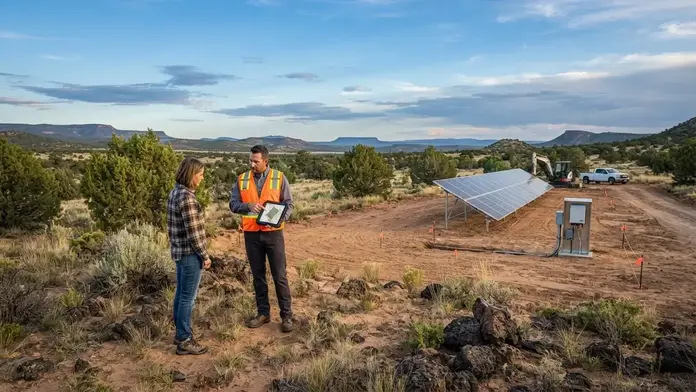
Rural off-grid solar projects should be planned around the property, equipment locations, electrical infrastructure, access, and applicable permitting requirements before construction begins.
A complete off-grid solar system is more than a collection of solar panels. Rural properties in Apache County typically require a coordinated combination of solar generation, battery storage, power conversion, electrical distribution, controls, mounting equipment, and wiring. The individual components must be selected and configured around the property's electrical demand, site conditions, equipment locations, access, and long-term development plans.
Understanding how these components work together can help property owners make better decisions before purchasing equipment or beginning site preparation. A system designed for a small seasonal cabin may look very different from one intended to power a full-time home, private well, workshop, barn, manufactured home, or larger rural property.
The following components commonly form part of a complete off-grid power system. The exact configuration depends on the property's electrical requirements, system design, equipment compatibility, applicable electrical requirements, and the recommendations of the qualified solar and electrical professionals designing and installing the system.
Solar panels generate electricity during periods of available sunlight. That electricity is managed by the system's charge-control equipment and used to supply electrical loads or charge the battery bank. Inverters convert stored or generated power into the form required by the property's electrical system. Distribution equipment, disconnects, wiring, monitoring equipment, and protective devices connect the major components and allow the system to operate as an integrated power system.
Battery storage provides energy when solar production is unavailable or insufficient, while a properly integrated generator can provide additional backup during extended periods of low solar production or unusually high electrical demand. The complete system therefore needs to be evaluated as a whole rather than selecting each component independently.
The photovoltaic array is the primary source of electricity in an off-grid solar system. Panels convert available sunlight into direct-current electricity that can be used by the system or stored in the batteries.
Array size depends on expected electrical consumption, solar exposure, seasonal conditions, system losses, battery requirements, and the property's desired level of energy independence. Ground-mounted arrays may also require suitable land, structural support, site preparation, and electrical trenching.
Charge controllers regulate electricity moving from the solar array into the battery storage system. They help manage charging according to the requirements of the batteries and the overall system configuration.
The type and capacity of charge-control equipment depend on the solar array, battery technology, system voltage, electrical design, and other equipment used throughout the installation.
Batteries store electricity generated by the solar array so that energy can be used when the panels are not producing enough power. This allows an off-grid property to operate after sunset and helps provide energy during periods of reduced solar production.
Battery capacity should be matched to expected electrical consumption, critical loads, desired backup duration, solar production, and the property's operating requirements. Battery location and environmental conditions should also be considered during system planning.
Inverters are responsible for converting electrical energy between the forms required by the solar, battery, and property electrical systems. They are a critical part of providing usable power to household and property loads.
Inverter capacity must account for expected continuous electrical demand as well as startup requirements from equipment such as pumps, compressors, HVAC systems, tools, and other high-demand loads.
Disconnects and related protective equipment provide controlled ways to isolate parts of the electrical system for maintenance, service, emergency situations, or other required procedures.
The specific disconnects, overcurrent protection, grounding, and other protective equipment required depend on the system design and applicable electrical requirements. These components should be selected and installed by appropriately qualified professionals.
Electrical distribution equipment delivers power from the solar and battery system to the property's electrical loads. Depending on the installation, this may include distribution panels, subpanels, breakers, disconnects, transfer equipment, and other electrical components.
Rural properties with multiple buildings may require careful planning of distribution routes and equipment locations to serve a home, well, shop, barn, garage, or other structures efficiently.
Monitoring equipment can provide information about solar production, battery condition, electrical consumption, system status, and other operating conditions. This information can help property owners understand how the system is performing.
Monitoring and control capabilities can be particularly useful on remote properties where identifying unusual energy consumption or system conditions early can help reduce unnecessary service trips.
Some off-grid properties incorporate a backup generator to provide additional power during extended periods of low solar production or when electrical demand exceeds available solar and battery capacity.
Generator integration can involve controls, transfer equipment, fuel storage, monitoring, and other components. The generator should be considered as part of the overall energy strategy rather than treated as an unrelated piece of equipment.
Some properties benefit from separating essential electrical loads from discretionary loads. A critical-load configuration can help prioritize equipment such as refrigeration, communications, security systems, basic lighting, water systems, or other essential property infrastructure.
Separating loads can make available battery capacity more useful during periods when solar production is reduced and can help prevent nonessential equipment from consuming energy needed for critical property functions.
Solar panels require an appropriate mounting structure capable of supporting the array under the property's environmental and site conditions. Depending on the property, panels may be roof-mounted, ground-mounted, pole-mounted, or installed using another suitable configuration.
Ground-mounted systems may require additional consideration of soil, rock, caliche, slope, vegetation, drainage, foundations or supports, equipment access, and site preparation.
Wiring and conduit connect the solar array, batteries, inverters, distribution equipment, buildings, wells, and other electrical loads. The required electrical infrastructure depends heavily on the distances between system components.
Long rural electrical runs can require additional conductors, conduit, trenching, protection, and equipment. Rocky ground, caliche, slopes, and difficult access can also affect the installation of underground electrical infrastructure.
An off-grid solar system should not be designed by choosing the largest available solar panels, batteries, or inverter independently. The components need to be compatible with one another and appropriately sized for the property's electrical loads, expected solar production, battery storage requirements, equipment locations, and operating conditions.
For example, a property with a private well may require inverter capacity capable of handling pump startup demand. A full-time residence may require substantially more battery storage than a seasonal cabin. A remote ground-mounted array may require additional structural work, clearing, grading, and trenching. A property with several outbuildings may also require longer electrical distribution runs and additional distribution equipment.
These relationships are why the complete system should be evaluated before equipment is purchased or permanent site work begins.
The right off-grid solar system is a coordinated combination of generation, storage, electrical conversion, distribution, protection, monitoring, and backup equipment. Understanding the complete system helps Apache County landowners plan solar alongside their home, well, septic system, driveway, grading, outbuildings, and future property improvements.
A complete off-grid power system combines solar generation, battery storage, inverters, electrical distribution, protection equipment, monitoring, and backup power into one coordinated system.
The cost of installing an off-grid solar system on rural Apache County property can vary substantially from one project to another. Unlike a simple grid-connected solar installation, a true off-grid system must generate and store enough electricity to serve the property when utility power is unavailable. The total investment therefore depends on the property's electrical demand, battery requirements, site conditions, equipment layout, and long-term development plans.
A small seasonal cabin with efficient appliances may require a relatively modest system, while a full-time rural residence can require substantially more solar generation, battery storage, inverter capacity, and backup power. Private well pumps, electric heating and cooling, water heating, workshops, agricultural equipment, and detached buildings can also increase the size and cost of the system.
Site conditions are another major consideration on undeveloped Apache County land. A ground-mounted solar array may require clearing, grading, excavation, mounting structures, electrical trenching, and equipment access. Rocky ground, caliche, slopes, long private roads, and remote equipment locations can add installation and mobilization costs that would not exist on an easily accessible residential property.
Two rural properties can have similar acreage and completely different solar costs. One may have a small seasonal cabin, short electrical runs, good access, and modest energy consumption. Another may require a large ground-mounted array, substantial battery storage, well-pump capacity, generator backup, long electrical trenches, and difficult excavation.
This is why a solar price advertised as a simple cost per panel or cost per watt should not automatically be interpreted as the price of a complete off-grid power system. Those figures may describe only part of the installation and may not include batteries, site preparation, trenching, electrical distribution, backup generation, or difficult rural site conditions.
For an Apache County property owner, the more useful question is not simply “How much does solar cost?” but rather “What will it take to power this particular property independently?” That answer starts with the property's intended use, electrical loads, solar exposure, battery requirements, access, terrain, well, buildings, and future development.
Understanding these cost factors before purchasing solar equipment can help rural landowners develop a more realistic project budget. Once the property's expected electrical demand and site requirements are understood, a qualified solar professional can determine the appropriate system size, equipment configuration, installation requirements, and final project cost.
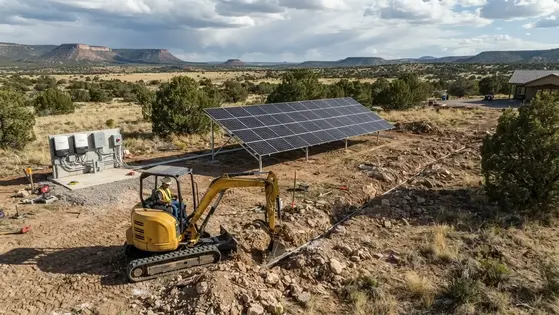
Ground-mounted solar can require clearing, grading, mounting preparation, equipment pads, electrical trenching, and reliable access before the photovoltaic system can be completed.
The cost of an off-grid solar system depends on the property and how you intend to use it. Electrical demand, battery storage, well pumping, terrain, access, trenching, ground-mounted equipment, outbuildings, and future construction can all affect the project scope. Apache County Land Services can help coordinate the broader development plan with qualified solar, electrical, excavation, well, septic, access, and other infrastructure professionals.
Call (928) 543-6447Off-grid solar costs in Apache County depend on much more than the number of panels. Solar capacity, battery storage, inverter equipment, mounting, electrical distribution, site preparation, trenching, access, terrain, and the property's actual electrical loads can all affect the final investment.
Conventional Arizona residential solar may be priced on a per-watt basis, but that figure should not be treated as the complete cost of an off-grid power system. Remote properties may require substantial battery storage, backup generation, longer electrical runs, ground-mounted arrays, well-pump capacity, and additional site work.
The most useful estimate starts with the property's intended use and electrical demand. A seasonal cabin can require a very different system from a full-time home with HVAC, appliances, a private well, workshop, and multiple outbuildings.
Often $15,000 – $30,000+
Smaller systems may serve cabins, RV properties, seasonal use, refrigeration, lighting, communications, and other modest loads. Battery capacity and site conditions can change the final cost.
Often $30,000 – $70,000+
Full-time homes generally require more generation and storage for HVAC, appliances, refrigeration, water heating, lighting, communications, and everyday household use.
Often $10,000 – $30,000+
Battery costs depend on daily consumption, critical loads, desired backup duration, battery capacity, inverter configuration, and how much energy independence the property requires.
Additional Site-Specific Cost
Ground arrays can add costs for mounting, excavation, grading, vegetation removal, drainage, equipment access, foundations or supports, and electrical trenching.
Varies By System Capacity
Inverters, disconnects, panels, wiring, controls, monitoring equipment, and other electrical components must be sized around the property's generation, storage, and electrical loads.
Additional Load-Dependent Cost
Well pumps can significantly affect system sizing. Pump horsepower, startup demand, pressure equipment, controls, and water storage should be included in the electrical load calculation.
Often $2,000 – $10,000+
Remote arrays may require underground connections between solar equipment, batteries, the home, well, or outbuildings. Length, depth, rock, caliche, access, and restoration affect excavation costs.
Custom Quote
Slopes, shallow rock, caliche, dense ground, vegetation, drainage, and limited working areas can increase installation difficulty and equipment requirements on rural acreage.
Additional Equipment & Installation
A backup generator can provide another layer of resilience during extended low-solar periods. Generator size, controls, transfer equipment, fuel systems, and installation location affect the additional investment.
Additional Load-Dependent Cost
Workshops, barns, garages, and agricultural buildings can add substantial loads from tools, compressors, lighting, refrigeration, pumps, and other equipment.
Custom Quote
Long private roads, gates, steep approaches, limited turning areas, and difficult staging conditions can increase the labor and equipment required to reach a remote Apache County installation site.
Often $50,000 – $100,000+
Larger properties with substantial battery storage, ground arrays, well pumping, backup generation, outbuildings, and extensive electrical distribution can require a significantly larger overall investment.
Two Apache County properties with similar solar arrays can have very different project costs. One may have easy access and modest electrical loads, while another may require extensive batteries, long electrical runs, well-pump capacity, difficult excavation, ground mounting, and generator backup.
A price-per-watt figure is therefore useful only as a preliminary reference for the solar-generation portion of the project. The complete budget should account for generation, storage, electrical equipment, installation, site conditions, access, trenching, and future development.
The best way to estimate an off-grid solar system in Apache County is to start with the property itself. Electrical demand, battery requirements, solar exposure, well pumping, equipment locations, terrain, access, trenching, future buildings, and backup power can all influence the final project investment.
An off-grid solar system should be designed for more than ideal sunny days. Rural Apache County properties can experience periods when solar production is reduced by clouds, storms, snow, shading, seasonal conditions, or unusually high electrical demand. A dependable system needs a strategy for maintaining essential power when the solar array is temporarily producing less energy than the property is using.
This does not necessarily mean installing an oversized solar array or relying on a generator every time production falls. A properly planned off-grid system can combine solar generation, battery storage, load management, energy reserves, and backup generation to keep important property systems operating while limiting unnecessary energy consumption during extended low-production periods.
The question for an off-grid property owner is not simply how many solar panels can be installed. The more important question is how the entire power system will behave when production is low and the property still needs electricity. Solar generation, battery storage, critical loads, high-demand equipment, private well pumping, energy management, and backup generation should be evaluated as parts of the same system.
For rural Apache County properties, planning for low-production periods before installation can help reduce the risk of discovering later that the system works well in ideal conditions but struggles during extended periods of limited sunlight or unusually high demand.
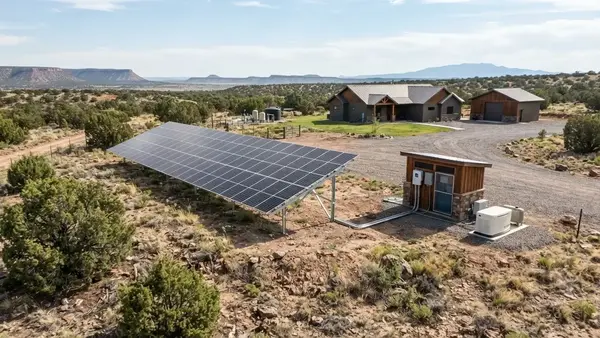
Larger rural power systems may need to support a home, private well, battery storage, backup generation, workshops, and other electrical loads across the property.
We connect rural property owners with qualified solar installation and electrical professionals throughout Apache County, Arizona. Our service area supports homeowners, cabin owners, ranchers, landowners, manufactured home owners, recreational property owners, and off-grid property owners who need dependable independent power where utility-grid service is unavailable, impractical, or not part of their development plan. Solar projects may include photovoltaic solar arrays, battery energy storage, inverters, electrical distribution equipment, ground-mounted solar systems, solar equipment installation, and related site preparation and electrical infrastructure based on the property's location, energy requirements, access, terrain, existing infrastructure, and long-term development plans.
If your property is located anywhere in Apache County or the surrounding rural communities, we can help connect you with solar professionals who can evaluate the property's solar potential, electrical requirements, available installation area, sun exposure, terrain, access, equipment locations, battery-storage needs, and related infrastructure. Off-grid solar conditions can vary significantly throughout the county, particularly on large-acreage parcels, remote homesites, high-elevation properties, ranch land, recreational properties, rocky or uneven terrain, and undeveloped or off-grid parcels. Your solar system should be designed around the property's actual energy requirements and site conditions rather than assuming the same system will work for every rural property.
Before installing an off-grid solar system on rural property, it helps to understand how the power system will fit into the property's larger development plan. Having basic information about the land, intended use, electrical loads, water system, buildings, access, terrain, and future improvements can help a qualified solar professional develop a more practical system design.
This checklist can help Apache County landowners organize the information they may need before requesting an off-grid solar evaluation. You do not need to have every answer before getting started. The purpose is to identify the major property conditions and development plans that can affect solar equipment sizing, placement, installation, electrical distribution, and future expansion.
Off-grid solar is often one component of a much larger rural property development project. The location of the solar array can affect grading, clearing, access, drainage, and electrical trenching. Battery and inverter locations can affect electrical runs and equipment access. Well and septic locations can affect available building areas and utility corridors. Future homes, shops, barns, and other improvements can also change the property's long-term electrical requirements.
Coordinating these considerations before construction begins can help reduce conflicts between permanent improvements and provide a clearer plan for the property's future infrastructure. Apache County Land Services can help property owners identify the development considerations that should be coordinated with qualified solar, electrical, excavation, well, septic, and other professionals.
You do not need to have every detail finalized before getting started. The goal is to give the solar professional enough information to understand how the property will be used, what electrical loads need to be supported, where major infrastructure may be located, and how the system may need to expand as the property develops.
Off-grid solar can provide an independent source of electricity for rural homes, cabins, ranch properties, manufactured homes, recreational properties, and remote development sites throughout Apache County, Arizona. Designing an effective solar system involves more than installing photovoltaic panels. Solar array size, battery storage, electrical loads, site conditions, sun exposure, equipment location, backup power, access, utility infrastructure, and the property's long-term development plans can all affect the system. The answers below address common questions about off-grid solar installation and rural solar power systems in Apache County, Arizona.
Get your rural property evaluated for the solar power system needed to support your planned development. Whether you are building a site-built home, manufactured home, cabin, ranch residence, seasonal property, recreational property, or fully off-grid homesite, solar installation involves more than placing panels on a roof or mounting them on the ground. Solar array size, battery storage, electrical loads, sun exposure, equipment locations, well pumps, septic components, utility routes, access, site preparation, future buildings, and applicable permitting requirements should all be considered as part of the property's larger development plan. Contact Apache County Land Services to discuss your property and get connected with qualified solar and electrical professionals who can evaluate the site's conditions, intended use, energy requirements, and project needs.
Call (928) 543-6447